Gérer un club de golf rentable dans le climat économique actuel s'apparente à naviguer sur un fairway étroit avec des limites hors-jeu des deux côtés. Entre l'augmentation des coûts de main-d'œuvre, l'inflation et les conditions météorologiques imprévisibles qui affectent les réservations de départs, les marges de la restauration (F&B) sont soumises à une pression sans précédent. Si vous vous demandez comment les clubs de golf peuvent réduire rapidement les coûts des boissons, vous n'êtes pas seul.
L'objectif principal de ce guide est de fournir des stratégies éprouvées et exploitables pour réduire rapidement les coûts des boissons sans compromettre l'expérience des membres ou des invités. Nous explorerons comment la maîtrise du contrôle des stocks de boissons, l'optimisation des négociations avec les fournisseurs et la mise en œuvre de techniques rigoureuses de réduction du gaspillage peuvent stabiliser instantanément vos résultats.
Selon Club + Resort Chef, les clubs de golf et de loisirs ne se comparent pas aux restaurants standards ; les pourcentages de coût des boissons attendus se situent généralement entre 25 et 30 % pour la bière, 30 et 35 % pour les spiritueux, et 40 et 48 % pour le vin [Club + Resort Chef]. Cependant, la différence entre un club fonctionnant avec un coût de 25 % et un autre à 35 % se résume souvent à la discipline opérationnelle. En mettant en œuvre les stratégies décrites ci-dessous, les exploitants de golf peuvent récupérer les revenus perdus et améliorer considérablement la rentabilité de leur restauration.
Le défi actuel des coûts des boissons
La gestion des coûts des boissons dans les clubs de golf présente des défis uniques que l'on ne retrouve pas dans les restaurants traditionnels. Les installations de golf gèrent des programmes de restauration (F&B) très décentralisés : un bar principal au club-house, un relais (stand de mi-parcours), des chariots de boissons mobiles et des distributeurs automatiques sur le parcours. Cette empreinte étendue rend le suivi des stocks et la minimisation des pertes incroyablement difficiles.
Pour comprendre l'ampleur du défi, les exploitants doivent maîtriser trois indicateurs clés et aborder les problèmes courants de gestion des stocks de bar avec des solutions pratiques:
- Coût au verre : Le coût des ingrédients utilisés dans une boisson divisé par son prix de vente.
- Pourcentage du coût des boissons : Coût total des ventes de boissons divisé par le revenu total des boissons sur une période donnée.
- Écart : La différence entre la quantité de produit vendue (selon le système de point de vente) et la quantité de produit réellement sortie de l'inventaire.
Gestion stratégique des stocks
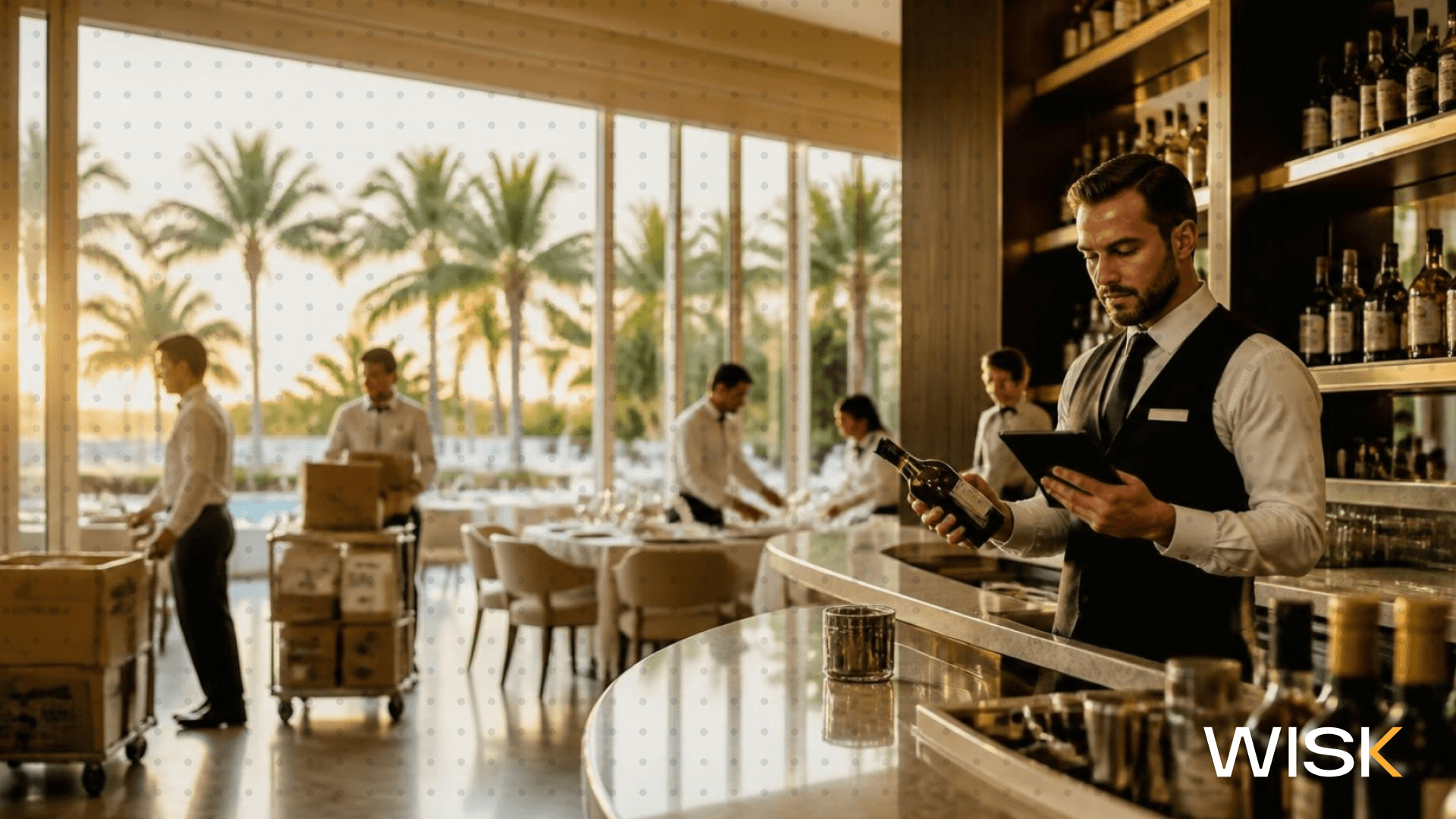
La base de tout effort visant à réduire les dépenses en boissons commence dans l'entrepôt. L'application d'une approche structurée à la gestion des stocks de bar et des spiritueux assure une gestion stratégique des stocks afin que les clubs n'immobilisent pas le capital d'exploitation nécessaire dans des stocks dormants tout en risquant des ruptures de stock sur les articles très demandés.
Systématiser l'entrepôt
L'implémentation du principe « premier entré, premier sorti » (FIFO) garantit que les stocks plus anciens (en particulier les articles périssables comme les IPA ou les bouteilles de vin ouvertes) sont utilisés avant les nouvelles livraisons. La définition de niveaux de par — la quantité minimale de produit nécessaire pour répondre à la demande jusqu'à la prochaine livraison — évite l'erreur classique des clubs de golf qui consiste à surcommander par peur. Tout comme les boissons lors d'événements de "pub golf" se voient attribuer un "nombre de par" pour standardiser le nombre de gorgées ou le taux d'alcool consommé, l'attribution d'un nombre de par aux articles en stock aide à standardiser et à rationaliser la gestion des stocks.
La création d'une fiche d'inventaire par pour votre programme de boissons soutient ce processus. Cela nécessite d'ajuster les niveaux de par en fonction des prévisions de demande saisonnière ; un club du Nord-Est devrait avoir des niveaux de par très différents pour les seltzers en canette en juillet par rapport à octobre.
Ces systèmes réduisent le gaspillage en prévenant l'expiration des produits et améliorent la trésorerie en gardant le capital en banque plutôt que de le laisser sur une étagère poussiéreuse. L'adoption d'habitudes et de routines cohérentes de contrôle des stocks de bar autour de ces processus contribue à les ancrer. Sécuriser les réserves d'alcool principales et exiger que tous les transferts vers les points de vente intermédiaires et les chariots de boissons soient enregistrés via une feuille de réquisition est une étape analogique simple pour réduire immédiatement les écarts.
Solutions d'inventaire numérique pour la gestion des tournées des bars
Il est fortement recommandé de passer des blocs-notes aux solutions numériques de gestion des stocks. En mettant en œuvre les meilleures pratiques pour la gestion des stocks et des commandes, en scannant les codes-barres et en se synchronisant directement avec les catalogues des fournisseurs, les responsables F&B peuvent réaliser l'inventaire en quelques heures plutôt qu'en plusieurs jours, réduisant ainsi considérablement les coûts de main-d'œuvre et les erreurs humaines.
Stratégies de négociation avec les fournisseurs et d'approvisionnement
Même avec des inventaires parfaits, payer trop cher le produit ruinera vos marges. Une réduction efficace des coûts dans l'hôtellerie de golf exige des relations proactives et stratégiques avec les fournisseurs. Tout comme les boissons sont attribuées à des trous spécifiques dans le pub golf, vous pouvez attribuer des produits ou des offres particuliers à certains fournisseurs pour optimiser l'approvisionnement et garantir le meilleur rapport qualité-prix.
Achats en volume et groupés
Les établissements de golf qui tirent parti des Groupements d'Achats (GPOs) ou négocient des accords de volume peuvent obtenir d'importantes remises de gros. Tout comme les participants se joignent à un groupe pour un événement de pub golf afin de maximiser le plaisir et la coordination, adhérer à un GPO permet aux établissements indépendants de bénéficier d'un pouvoir de négociation collectif et d'accéder à des niveaux de prix généralement réservés aux grands groupes d'hôtellerie d'entreprise. Alternativement, les opérateurs peuvent négocier des accords d'achat en volume directement avec les distributeurs en s'engageant sur des livraisons de caisses spécifiques en échange de remises importantes.
Tactiques de négociation étape par étape
- Consolidez vos fournisseurs : Au lieu d'acheter auprès de six fournisseurs différents, concentrez votre pouvoir d'achat sur deux ou trois.
- Planifiez vos contrats : Négociez des contrats saisonniers juste avant votre haute saison (par exemple, avril pour les clubs du Nord), lorsque les distributeurs sont désireux de s'assurer vos mois de fort volume.
- Évaluez les fournisseurs alternatifs : Demandez chaque année des devis à l'aveugle à des distributeurs concurrents pour vos alcools de base et vins de la maison.
- Demandez des services à valeur ajoutée : Si un fournisseur ne peut pas baisser ses prix, négociez des verres de marque gratuits, des parrainages de parasols pour la terrasse ou des sessions de formation gratuites pour le personnel.
Consolider les achats de bière nationale auprès d'un seul distributeur et signer des accords de droits de distribution exclusifs pour les alcools de base est un moyen éprouvé de réduire les pourcentages de coûts globaux des boissons en un seul trimestre fiscal.

Techniques de réduction du gaspillage pour les événements de jeux à boire
Le gaspillage est le tueur silencieux de la rentabilité de la restauration. Qu'il s'agisse d'un fût mousseux, d'un barman trop généreux ou de boissons renversées, minimiser le gaspillage physique est un moyen rapide d'améliorer les marges. Au pub golf, renverser sa propre boisson ou celle d'un autre joueur coûte 3 coups de pénalité, illustrant comment d'autres événements pénalisent le gaspillage pour encourager la responsabilisation.
Système de tirage et protocoles de service
Selon une étude Kegonomics de SteadyServ publiée dans Bar & Restaurant News, « En moyenne, plus de 20 % de la bière de chaque fût est gaspillée, simplement parce qu'on devine la quantité restante ». De plus, la perte de bière pression peut atteindre 18 à 30 % en raison de la mousse et des problèmes liés aux fûts.
C'est une perte considérable pour les clubs de golf qui dépendent fortement de la bière pression au tournant. Pour y remédier, les clubs doivent mettre en œuvre des protocoles rigoureux d'entretien du système de tirage. Les conduites doivent être nettoyées toutes les deux semaines, et les refroidisseurs à glycol doivent être entretenus pour garantir que la température de la bière reste entre 2,2 et 3,3 °C. La bière chaude mousse, et la mousse équivaut à des revenus perdus.
De plus, la formation du personnel aux techniques de service appropriées est non négociable. Les barmans et les préposés aux chariots de boissons doivent être formés sur :
- Le service à 45 degrés : Standardiser la façon de servir une bière pression.
- Standardisation du contrôle des portions : Interdire le « service à main levée » pour les cocktails. L'utilisation de doseurs garantit qu'une portion de 1,5 oz est exactement de 1,5 oz. Un surdosage d'à peine un quart d'once par boisson peut considérablement augmenter les coûts d'alcool lors d'un week-end de tournoi chargé. Pour la bière pression, la standardisation des tailles de service – comme s'assurer que chaque pinte est versée avec précision – permet non seulement de contrôler les coûts, mais aussi de maintenir la cohérence pour les clients.
- Suivi des pertes : Utiliser un « registre des pertes » où le personnel doit consigner les boissons renversées, les articles retournés ou les services mousseux. Cela crée une responsabilisation.
Un défi courant est la résistance du personnel aux doseurs. La solution consiste à le présenter non pas comme une punition, mais comme un engagement envers la constance des boissons, assurant aux membres que leur cocktail préféré aura exactement le même goût à chaque fois.
Ingénierie du menu et stratégies de prix
La façon dont vous présentez vos boissons a un impact profond sur ce qui est vendu et, par conséquent, sur vos marges bénéficiaires. L'ingénierie du menu est la conception psychologique de vos offres. Les bars des clubs de golf proposent des plats copieux de style pub, des sandwichs et des hot-dogs, adaptés à une collation rapide ou à un repas complet.
Lors de la planification de votre menu, envisagez de créer des plats uniques ou des offres spéciales thématiques pour stimuler les ventes. Les options populaires de sandwichs et de hamburgers comportent souvent des garnitures fraîches telles que de la laitue, de la tomate, de l'oignon et du bacon, qui améliorent à la fois la saveur et la présentation. Le hot-dog classique est également une option pratique et rapide qui plaît à de nombreux clients.
Pour stimuler davantage l'engagement, envisagez d'offrir des prix pour des défis basés sur le menu ou pour les articles les plus vendus, ajoutant ainsi un élément compétitif et amusant à vos promotions.
Placement stratégique et tarification
Les clubs de golf devraient appliquer cela en identifiant leurs « Stars » (articles à forte marge et très populaires) et en les mettant en avant. Par exemple, si votre cocktail « Transfusion » a une marge de contribution élevée et est un favori des clients, vous pouvez le présenter en haut de votre menu de mi-parcours avec une description alléchante pour attirer l'attention et stimuler les ventes. Inversement, les « Dogs » (articles à faible marge et peu populaires) devraient être entièrement supprimés.
Ajustements et vente incitative avec une fiche de score de pub golf
- Ajustements saisonniers du menu : Passez aux spritzers plus légers et à marge plus élevée, ainsi qu'aux hard seltzers en canette en été, et aux spiritueux haut de gamme et plus foncés en hiver. Les offres de menu et les prix peuvent varier en fonction de la saison, de l'événement ou des préférences des clients.
- Formats de service alternatifs : Proposez un prix « pichet » pour la bière pression en terrasse. Bien que le pourcentage de marge puisse légèrement diminuer, le volume d'argent déposé en banque augmente considérablement, et cela réduit le travail des barmans qui versent des pintes individuelles.
- Techniques de vente incitative : Formez le personnel des chariots de boissons à demander : « Souhaitez-vous un double pour seulement 4 $ de plus ? » La marge sur l'alcool supplémentaire est incroyablement élevée, ne nécessitant aucune main-d'œuvre ou emballage supplémentaire.
Solutions technologiques pour le contrôle des coûts
La technologie moderne offre un bouclier contre les fuites traditionnelles dans le programme de boissons d'un club de golf. Tout comme un événement de pub golf s'appuie sur une fiche de score pour suivre les points, la progression et garantir le fair-play, les systèmes de suivi et de reporting numériques fournissent aux bars des clubs de golf des enregistrements précis et en temps réel de l'inventaire, des ventes et des performances du personnel. Ce niveau de détail aide les gérants à identifier rapidement les écarts, à surveiller les tendances et à prendre des décisions éclairées pour optimiser les opérations.
Logiciels et intégrations
Selon WISK.ail'approche de WISK.ai en matière d'automatisation de l'inventaire et des achats, les entreprises du secteur de l'hôtellerie peuvent raccourcir le chemin vers le retour sur investissement (ROI) en réduisant les commandes excessives, le gaspillage et le travail manuel.
Dans de nombreux établissements, le retour sur investissement provient d'un contrôle plus strict des stocks, de décisions d'achat plus intelligentes et d'une meilleure visibilité sur les fuites de coûts de boissons.
Cela reflète un changement clair dans l'industrie : le suivi manuel devient moins pratique pour les opérateurs occupés. Le meilleur logiciel de gestion des stocks de boissons, tel que WISK.ai, s'intègre parfaitement à votre système de point de vente (POS) pour fournir des rapports d'inventaire théorique vs réel en temps réel. Les fonctionnalités clés à rechercher incluent :
- Outils de suivi des pertes: Registres numériques pour les déversements, les offerts et la casse.
- Commande automatisée : Suggestions de bons de commande basées sur les niveaux de par, l'utilisation et les niveaux de stock actuels, aidant à prévenir les commandes excessives.
Bien qu'il y ait un coût initial pour la mise à niveau de votre gestion des stocks et de votre flux de travail POS, les gains à long terme résultant de la réduction des pertes, de la diminution des coûts de main-d'œuvre et d'un meilleur contrôle des achats en font un investissement judicieux pour les opérateurs sérieux.
Calendrier de mise en œuvre et gains rapides pour un événement "Pub Golf"
Tenter de tout corriger en même temps submergera votre personnel. Une approche progressive assure un succès durable. Traitez chaque phase comme un événement ou une initiative formelle, en la planifiant et en la structurant soigneusement pour renforcer la responsabilisation et l'engagement.
Plan d'action sur 30 jours
- Semaine 1 : Mettez en œuvre un contrôle des portions standardisé (jiggers obligatoires) et organisez une session de formation complète du personnel sur la nouvelle politique. Marquez cette tâche comme terminée avant de passer à la Semaine 2.
- Semaine 2 : Sécurisez toutes les réserves. Limitez l'accès aux clés aux seuls managers et mettez en place une feuille de sortie obligatoire pour tous les transferts de stock vers les chariots de boissons. Assurez-vous que ces actions sont terminées avant de passer à la Semaine 3.
- Semaine 3 : Effectuez un nettoyage et un entretien approfondis de vos systèmes de bière pression pour éliminer les pertes de mousse. Confirmez que cette tâche est terminée avant le début de la Semaine 4.
- Semaine 4 : Analysez les prix des fournisseurs et contactez des fournisseurs alternatifs pour des devis à l'aveugle pour les alcools de base. Marquez cette phase comme terminée avant d'examiner les progrès globaux.
Le principal obstacle à ces gains rapides est la résistance du personnel (« nous avons toujours fait comme ça »). Surmontez cela en impliquant le personnel clé dans le processus — offrez une prime à votre chef barman si l'écart mensuel des coûts de boissons descend en dessous de votre objectif de 2 %.
Conclusion
Réduire les coûts de boissons d'un club de golf ne vise pas à compromettre l'expérience des membres ; il s'agit d'opérer avec une précision professionnelle. En maîtrisant votre inventaire, en négociant fermement avec les fournisseurs, en éliminant le gaspillage physique, en optimisant vos menus et en adoptant les technologies modernes, vous pouvez protéger la santé financière de votre établissement.
Lorsque les coûts de boissons représentent une part si importante des dépenses de restauration et de bar, chaque point de pourcentage économisé impacte directement le résultat net, permettant au club de réinvestir dans l'état du parcours ou les salaires du personnel.
Appel à l'action : N'attendez pas la fin de la saison pour revoir vos marges. Choisissez une stratégie de « gain rapide » de cette liste — comme la mise en place de doseurs obligatoires ou le verrouillage de la cave à spiritueux principale — et mettez-la en œuvre cette semaine.