Quick Answer: A strong dynamic pricing strategy lifts your hotel revenue by 10-25% over static models. By segment: business travelers respond best to steady midweek rates with 5-15% tweaks and length-of-stay incentives; leisure guests handle 20-40% swings around events or weekends.
Factor in ancillary spend and you can push total guest value up another 15-40%. Hotels that get this right see every optimized booking flow straight to the bottom line. In 2026 the industry baseline sits at modest 0.6% RevPAR growth, but dynamic users consistently outperform that.
What Is Dynamic Pricing?
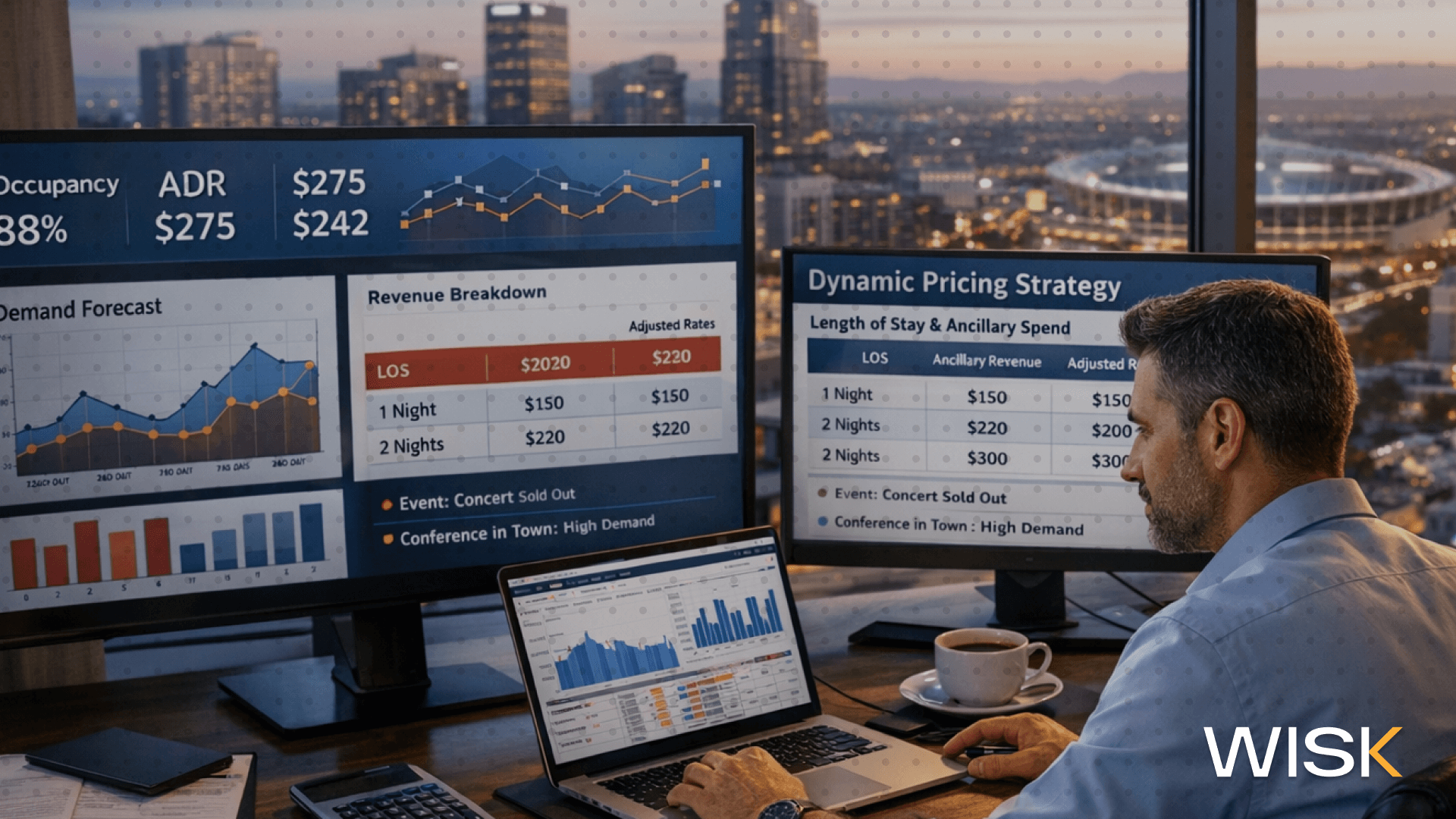
Dynamic pricing means you adjust room rates in real time based on market demand, competitor rates, local events, booking patterns, and even the length of stay your guests choose. It shows exactly how efficiently your hotel turns available inventory into revenue and profit.
Here is the simple way most operators look at it:
Revenue Capture % = (Actual Room Revenue + Ancillary Spend) ÷ (Potential Revenue at Optimal Rates) × 100
Take a 100-room property with a $220 base rate. On a high-demand night with a big local event you might push rates to $280 and add a minimum two-night stay. If you fill 85 rooms at that level plus $65 average ancillary per guest, you capture far more than the old fixed-rate approach ever could.
The flip side of dynamic pricing is your total revenue yield. A well-run program often delivers 80-90% capture of available revenue, which is why it now sits at the heart of any profitable hotel pricing strategy. Airlines started this decades ago. Hotels picked it up through yield management in the 1990s. Today AI and real-time data have turned it into something every independent hotel and chain can use without a full revenue team.
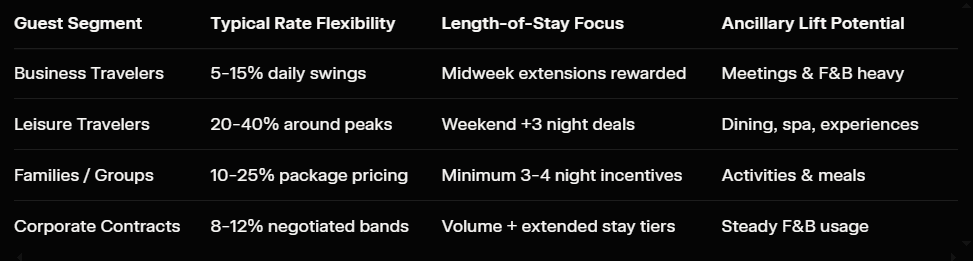
Dynamic Pricing Benchmarks by Guest Segment
Different guests react differently to rate changes, so your targets shift with the crowd walking through the door.
Dynamic Pricing Benchmarks by Hotel Type
Your property type also sets the realistic range you should hit.
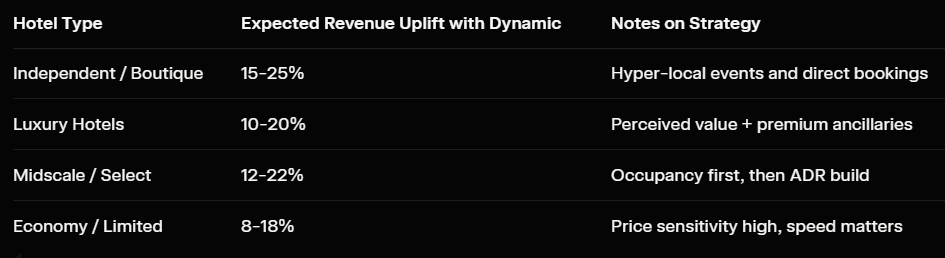
Data from operators using modern tools shows average lifts land around 19% when length-of-stay pricing and ancillary bundles join the mix.
How to Implement Your Dynamic Pricing Strategy
Method 1: Basic Historical Review (Weekly Check)
Pull last year’s data plus current booking pace.
Example: Your 150-room hotel averaged $195 ADR last February at 68% occupancy. This year pace shows 15% more demand because of a nearby conference. Raise base rates 12% and add a two-night minimum. Simple math shows the revenue potential jumps immediately.
Method 2: Segment + Length-of-Stay Pricing
Break rates by guest type and nights booked.
A leisure booking for four nights might drop 10% per night after the third. That same room on a one-night corporate stay stays at full rate. Guests who stay longer spend about 40% more per night on food and beverage, so the math works in your favor.
Method 3: Ideal vs. Actual Revenue
Your ideal revenue comes from the revenue management system forecast using real-time data, competitor pricing, and demand forecasts. Actual revenue is what hits the bank.
The gap tells the real story.


What Causes Missed Revenue Opportunities?
If your numbers sit below target, these usual suspects almost always show up.
1. Static pricing model
You set rates once a month and walk away. Demand spikes and you leave money on the table while the property fills at yesterday’s price.
2. Ignoring length of stay pricing strategies
Short stays create high turnover costs and empty shoulder nights. One extra night per booking often adds more profit than a 20% rate increase.
3. Forgetting ancillary spend
You price rooms perfectly but never bundle or promote the restaurant, spa, or parking. Longer stays from smart length-of-stay pricing can lift F&B revenue 30-40%.
4. Slow reaction to competitor pricing
Your neighbor drops rates for a festival and you only notice after the weekend ends.
5. Weak property management system integration
Rates live in three different places. Updates take hours instead of minutes.
6. No real guest segmentation
You treat business travelers and weekend leisure guests the same, so you either scare off price-sensitive guests or leave money from those who value flexibility.
Seven Practical Ways to Maximize Revenue in 2026
1. Connect real-time data feeds
Link your PMS, channel manager, and local event calendar. Rates update automatically when demand trends shift.
2. Make length of stay your secret weapon
Offer sliding discounts after night two or three during off-peak periods. Require minimum stays during peaks. Hotels that do this see occupancy rise 8-12% and direct bookings climb because guests feel they win.
3. Bundle value-added pricing
Pair room rates with breakfast, late checkout, or parking at a package price that still beats à la carte. Guests perceive higher value and your ancillary capture jumps.
4. Segment and personalize
Business travelers get flexible cancellation and points. Leisure guests see family packages. Different price sensitivity means you can charge each group what they are willing to pay.
5. Watch competitor rates daily
Set alerts for your comp set. When they move, your system suggests a measured response instead of panic pricing.
6. Use demand-based pricing rules
Create guardrails: never drop below 85% of last year’s rate in shoulder season, never exceed 130% without a minimum stay. Rules keep you disciplined.
7. Review and adjust monthly
Look at actual vs forecast, length-of-stay mix, and ancillary per guest. Tweak one lever at a time so you learn what actually moves the needle for your hotel’s location and guest mix.
Dynamic Pricing vs. Other Metrics
Dynamic pricing works best when you track it alongside the full picture.

Dynamic Pricing Quick Calculator
Plug in your numbers for a fast sense of what is possible.
• Current ADR: $_____
• Average Occupancy: _____ %
• Rooms: _____
• Current Monthly Room Revenue: $_____
Add a conservative 12% uplift from dynamic pricing plus length-of-stay and ancillary focus:
Potential Monthly Revenue = $_____ (that extra amount goes straight to profit when costs stay controlled).
Frequently Asked Questions
What is the difference between dynamic pricing and cost-based pricing?
Cost-based pricing adds a markup to your variable costs. Dynamic pricing starts with market demand and competitor rates first, then protects your margins. Most profitable hotel pricing strategy today blends both but lets demand lead.
How do independent hotels stay competitive with chains?
Hyper-local data and fast adjustments. Chains move slower; you can react to a neighborhood concert or road closure within hours and capture the surge.
What role does length of stay play in hotel room pricing?
Huge. Extending the average stay by even half a night often adds more total revenue than raising the nightly rate, because turnover costs drop and guests spend more on additional services.
Should I worry about guest satisfaction when rates change?
Transparency wins. When guests see why rates move (big local event, limited rooms) and you offer clear value bundles, acceptance stays high. Surveys show 65% of travelers now expect hotels to adjust rates during busy periods.
How often should I review my pricing rules?
Weekly for real-time data, monthly for deeper strategy, and quarterly for full reset. Markets move fast in 2026.
Can dynamic pricing work for small hotels with limited staff?
Absolutely. Modern revenue management systems do the heavy lifting so you only step in for big decisions.
Track Your Dynamic Pricing Automatically with WISK
Manually watching rates, length-of-stay patterns, and competitor moves eats hours every week and still leaves gaps. Modern revenue management systems pull real-time data from your property management system, forecast demand patterns, and suggest rate changes across all distribution channels. They handle the room side beautifully, especially when paired with essential tools every restaurant manager needs on the F&B side.
But here is where many hotels still leak profit: the restaurant and bar that sit inside the property. Those longer stays you create with smart length-of-stay pricing bring guests who eat and drink more, so applying practical tips to increase bar sales directly impacts the total value of each booking. If your F&B costs are not locked down with inventory management software for bars and restaurants, that extra ancillary revenue disappears.
That is exactly where WISK shines for hotel restaurants and bars. WISK bar inventory software connects your POS sales with real-time inventory counts, calculates pour cost automatically, flags variances, and helps you protect every margin on the drinks and food those extra guest nights generate. You get the same real-time clarity on the F&B side that your revenue management system gives you on rooms, plus recipe management and food cost controls that keep margins stable as volume grows. The combination turns a good dynamic pricing strategy into a complete revenue engine.
Ready to see the difference? Book a quick demo or review WISK pricing and plans and we will show you how hotels just like yours are pairing dynamic room rates with bulletproof restaurant operations to keep more of what they earn.
Sources
• CoStar and Tourism Economics 2026 US Hotel Forecast via [Hotel Dive] (https://www.hoteldive.com/news/hotel-industry-performance-2026-costar-tourism-economics/810703/)
• Traveler attitudes toward dynamic pricing in [SiteMinder 2026 Global Booking Trends] (https://www.siteminder.com/r/latest-trends-in-hotel-industry/)
• Length-of-stay pricing performance data from [RoomPriceGenie case studies] (https://roompricegenie.com/length-of-stay-pricing-boosts-revenue/)