The Bottom Line: A busy hotel bar generates high revenue through sheer volume but often bleeds cash through unmeasured waste, whereas a profitable hotel bar leverages strict pour cost monitoring and variance reports to retain every possible cent. WISK.ai provides the exact operational visibility needed to transform high-volume traffic into maximized, trackable profit margins without slowing down your service.
Why does high foot traffic in a hotel bar not always equal high profit margins?
High foot traffic masks operational inefficiencies like overpouring, theft, and unoptimized pricing, which can silently erode up to 20% to 25% of gross beverage revenue. True profitability requires isolating these invisible leaks rather than just relying on sheer sales volume to cover spiraling costs.
When you look across a packed lobby bar at 9:00 PM on a Friday, it is easy to assume the property is making money. The registers ring non-stop, and energy is high. But volume is top-line vanity. If you sit on the finance team, you know gross sales tell you nothing about business health. In a high-volume environment, fast-moving bartenders prioritizing speed over precision create compounding mistakes.
- The "Heavy Hand" Tax: Overpouring by a quarter-ounce on a premium spirit seems negligible. Across 500 cocktails, it destroys shift margins.
- Unrecorded Comps: Spilled drinks or VIP pours often go unrecorded in the point-of-sale (POS) system, skewing inventory.
- Dead Stock: Selling thousands of vodka sodas while $15,000 of liqueurs gather dust ties up operating capital and reflects deeper bar inventory management issues.
According to standard benchmarks on beverage program profitability, failing to track these metrics means your gross sales subsidize chaos.
How can beverage directors accurately identify where profits are leaking?
Beverage directors must implement automated variance reports and continuous pour cost monitoring to compare exact theoretical inventory depletion against actual physical inventory counts. This approach immediately flags discrepancies down to the fraction of an ounce, rescuing an average of 3% to 5% of total revenue within the first 30 days.
You cannot fix what you do not measure. Traditional hotel bar setups require end-of-month post-mortems to identify profit leaks. By the time accounting flags a spike in liquor costs, the damage is done. The inventory is gone, and the specific cause is untraceable.
Variance reports are the ultimate truth-tellers, removing emotion from management. When your POS shows 40 ounces of premium tequila sold, but physical inventory shows 55 ounces missing, you have a 15-ounce variance. Doing this manually once a month buries that variance in a massive, unactionable spreadsheet, underscoring the need for structured bar inventory control processes. Consistent, tech-enabled pour cost monitoring shifts the conversation from guessing to knowing. Address specific trends proactively:
- Targeted Retraining: Identify shifts with variance spikes to retrain bartenders on jiggering.
- Equipment Audits: Replace faulty pour spouts dropping extra volume.
- Shrinkage: Spot missing high-value bottles without corresponding POS data to tighten security.
What is the exact financial impact of automated recipe costing on bar profitability?
Dynamic recipe costing ensures that cocktail pricing instantly reflects real-time vendor price fluctuations, protecting profit margins and preventing bars from losing $1.50 to $3.00 per drink on outdated menus. Hotel properties utilizing automated costing systems maintain a healthy 15% to 18% liquor cost average despite supply chain inflation.
Supply chain volatility is our industry's norm. Base spirits, fresh citrus, and specialty modifier costs fluctuate constantly, which is why robust recipe management and cost software is critical. Running a high-volume bar with a static menu priced six months ago actively loses money on every transaction.
Think about a signature cocktail containing five ingredients. If premium agave prices rise 8% and lime juice jumps 12%, an original 18% pour cost suddenly pushes 24%. You absorb that margin compression hundreds of times a night. Automated recipe costing connects your most recent invoice price directly to menu items. This operational linkage allows you to:
- Identify Profit Drains: See which cocktails are financially unviable based on weekly deliveries.
- Pivot Instantly: Make immediate decisions to raise prices or swap ingredients, maintaining margins.
- Eliminate Loss Leaders: Prevent complex drinks from becoming hidden losses inside high-volume sales.
A comprehensive analysis on hospitality cost control emphasizes that static pricing drives margin compression. If you don't know the exact cost of a poured drink, you run a charity.

How do profit margin analytics change decision-making for hotel owners?
Real-time profit margin analytics shift management from reactive end-of-month damage control to proactive, data-driven daily adjustments, increasing overall beverage program profitability by up to 15% annually. This granular data allows finance teams to identify exactly which spirits and cocktails drive the highest net return per glass.
For hotel owners and finance teams, the beverage program often acts as a black box. You see labor costs, purchasing invoices, and total revenue, but the operational space between is murky. Profit margin analytics illuminate that black box, transforming raw data into highly actionable asset management strategies.
With real-time analytics, you stop making decisions based on gut feelings. Instead, you conduct strategic menu engineering based entirely on financial yield, aligning your initiatives with proven tips to increase bar sales. You will know instantly that while Cocktail A is your top seller by volume, Cocktail B delivers a 30% higher net profit per glass. Armed with that specific data, management executes precise adjustments:
- Staff Incentives: Instruct staff to push Cocktail B during high-volume rushes.
- Physical Placement: Move high-margin items to prominent menu real estate.
- Inventory Optimization: Phase out low-margin, high-prep cocktails slowing down service.
Implementing robust data tracking helps organizations pivot to predictive profitability modeling. It holds directors accountable for the actual yield of purchased inventory.
What is the difference between manual inventory management and using WISK.ai?
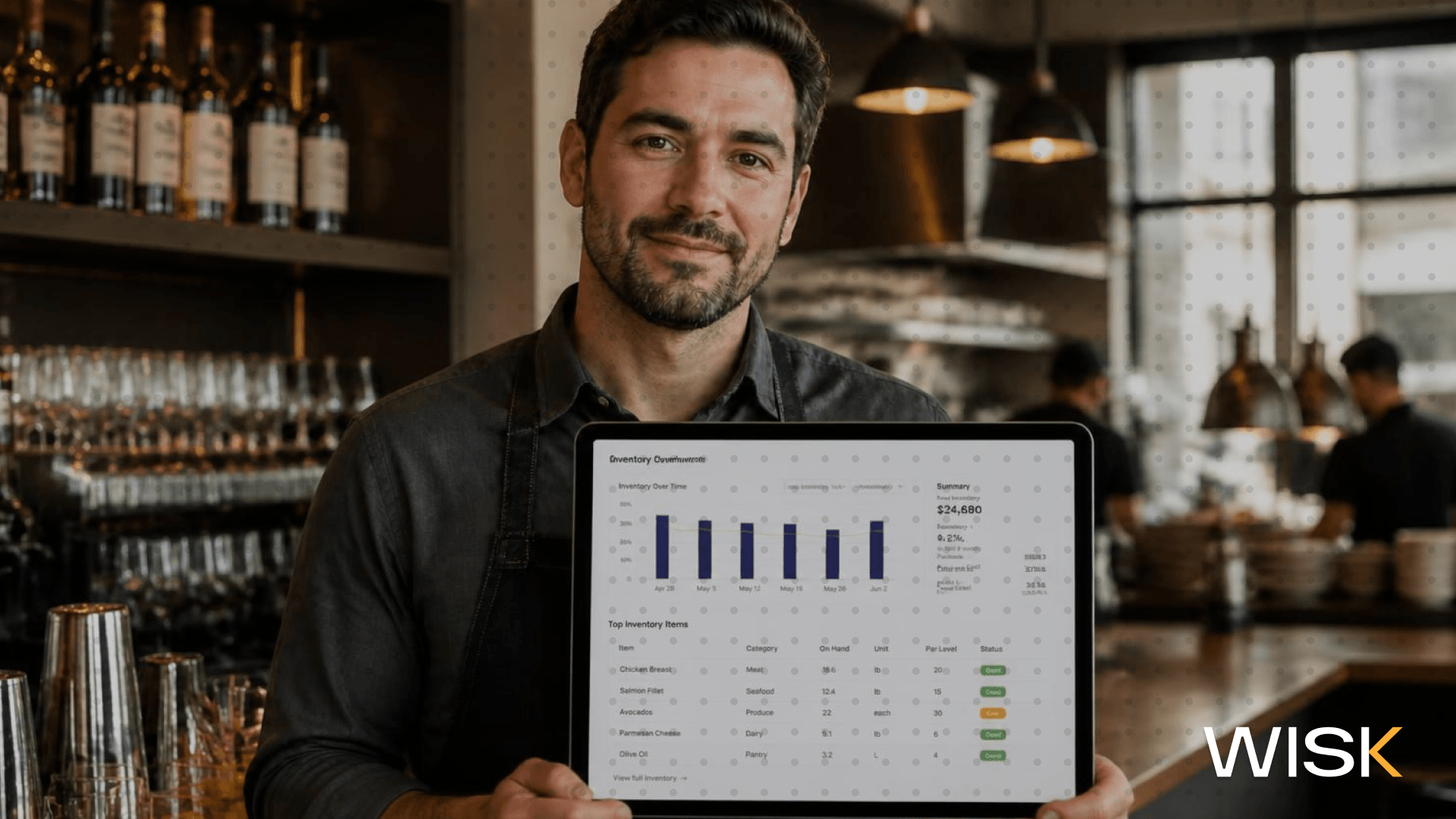
Manual inventory relies on slow, error-prone spreadsheets that take 12 to 15 hours per month, while WISK.ai reduces inventory counting time by 80% through Bluetooth scale integration and a massive database of over 200,000 items.
No hospitality professional wants to stand in a cold liquor room at 3:00 AM guessing whether a gin bottle is "0.4" or "0.5" full. Manual inventory is wildly inaccurate and incredibly expensive considering the hourly wages of the management team, especially when compared with a structured 10-step guide to measuring liquor bottles. It inevitably leads to staff burnout and high turnover. Transitioning to a purpose-built system eliminates human error and drastically reduces compliance labor costs.
How does managing multiple hotel bar outlets compound these operational challenges?
Operating multiple bar concepts within a single hotel property multiplies inventory errors, cross-transfers, and inconsistent pricing, resulting in a minimum 10% loss of potential profit across the entire beverage program. Centralized software eliminates these blind spots by treating each outlet as a distinct profit center while unifying purchasing power.
Running a lobby bar, rooftop lounge, pool bar, and banquets department simultaneously is an operational minefield that demands disciplined bar stock control habits. The biggest leak in multi-outlet properties is internal transfers.
When the rooftop bar runs out of vodka, the manager grabs a case from the lobby. If unlogged, the lobby bar’s pour costs look catastrophic on Monday, while the rooftop bar seemingly generates revenue from zero inventory. This destroys property-wide data integrity.
Furthermore, managing purchasing across multiple outlets without centralized systems means missing massive distributor volume discounts. You need a system accurately tracking movement between distinct venues, ensuring every drop is accounted for. Centralization ensures unified purchasing, standardized pricing, and accurate per-venue P&L reports.
How can WISK.ai transform your hotel bar from just busy to highly profitable?
WISK.ai transforms busy hotel bars into profit-generating machines by completely automating pour cost monitoring, variance reports, and recipe costing, directly increasing your bottom line. By eliminating the guesswork and manual labor from beverage management, you regain control over every drop poured.
We built WISK bar inventory software because we know how frustrating it is to generate massive sales and have nothing to show on the P&L. You work too hard to let 20% of revenue evaporate through inefficiencies and outdated spreadsheets.
Your beverage directors need to focus on guest experience and menu innovation, not dawn data entry, which is why arming them with essential restaurant management tools is so impactful. By integrating our platform, your team instantly spots profit leaks, adjusts pricing dynamically, and understands true operational costs. Stop letting profits walk out the door. Take control of your inventory today. Book a demo with WISK.ai today and turn high foot traffic into undeniable profit.