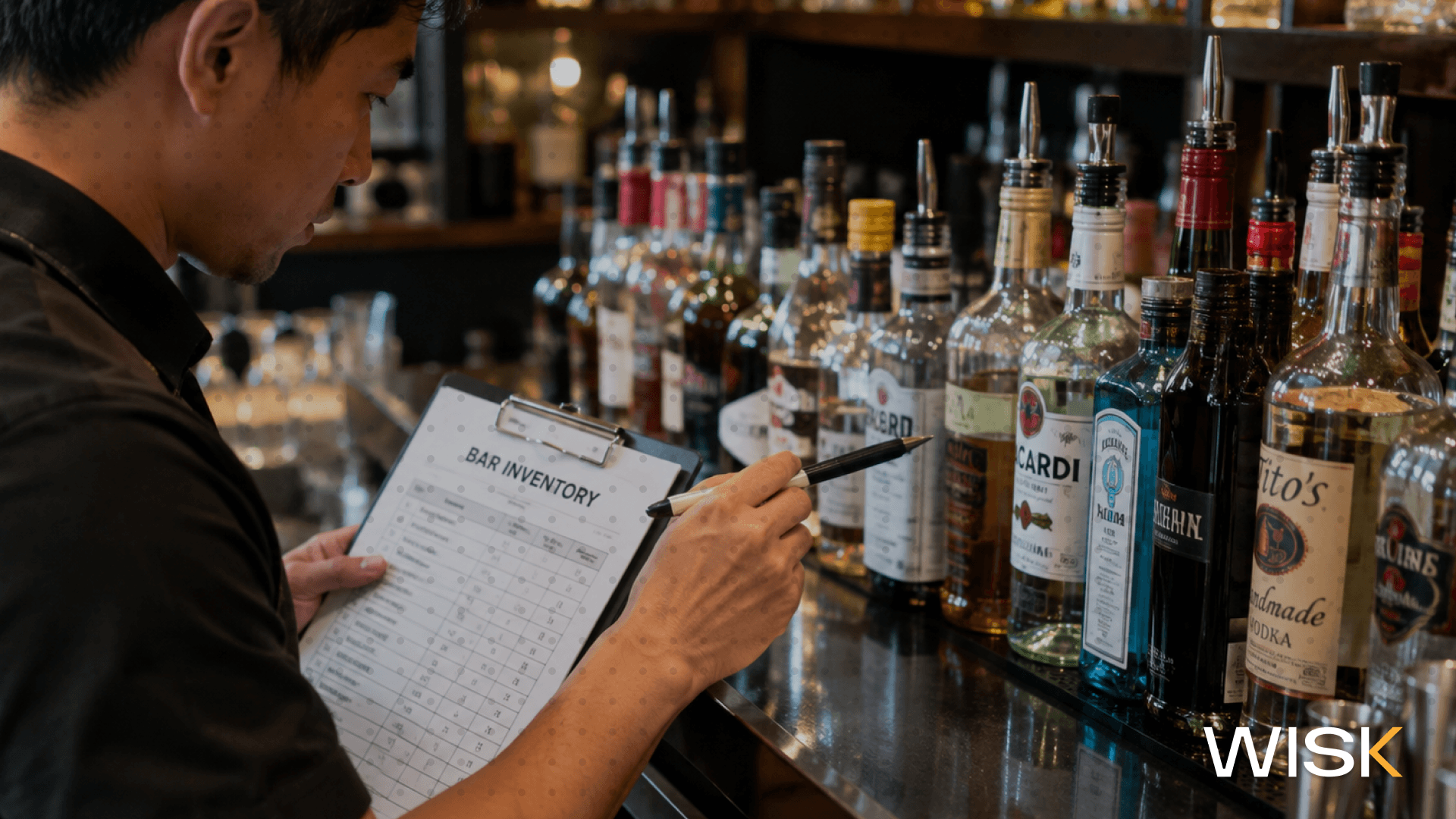
En résumé : La meilleure façon de fixer le prix des boissons de qualité est de viser un coût de distribution strict de 15 % à 18 % en calculant en permanence le coût exact par once de vos bouteilles de puits et en fixant les prix de détail sur la base de recettes précises et standardisées. Les directeurs des boissons et les gérants de bars y parviennent de manière durable en utilisant WISK pour automatiser le suivi des coûts de coulée et détecter les écarts en temps réel, garantissant ainsi que les volumes élevés de boissons de puits génèrent des revenus sans éroder secrètement le total rentabilité du bar.
Comment calculez-vous le coût réel d'un verre de puits ?
Pour calculer le coût réel d'une boisson de puits, il faut diviser le prix de gros de la bouteille par le total des onces, puis multiplier ce coût par once par le volume exact de la boisson, en ajoutant 0,10$ à 0,25$ supplémentaires pour tenir compte du coût des mélangeurs et des garnitures.
Écoutez, vous ne pouvez pas simplement deviner le coût de votre puits en vous basant sur le prix du bar du coin de la rue. Vous devez faire le calcul, et vous devez le faire chaque fois qu'une nouvelle facture arrive. Si vous payez 14$ pour une bouteille de 1 litre (33,8 onces) de vodka Well, le coût de votre liqueur brute est d'environ 0,41$ l'once. Si vous achetez un standard 750 ml bouteille (25,4 onces) pour 12$, votre coût passe à 0,47$ l'once. Un verre standard de 1,5 once par litre vous coûte 0,62$, tandis que le même versement provenant d'une bouteille de 750 ml coûte 0,71$. Mais s'arrêter là est une grave erreur.
- Prenez en compte les modificateurs : Du soda au pistolet, un soupçon de canneberge et un quartier de lime ne sont pas gratuits. Si votre quartier de lime coûte 0,08$ et votre sirop de soda coûte 0,05$, le coût réel de votre boisson dans cette bouteille d'un litre est de 0,75$, et non de 0,62$.
- Mettez constamment à jour les coûts : Les prix de gros des boissons alcoolisées fluctuent. S'appuyer sur des coûts de gros obsolètes d'il y a six mois est le moyen le plus rapide de perdre des marges. Vous devez baser vos calculs sur le dernier prix d'achat, et non sur la moyenne historique.
- Comprenez l'impact sur les prix : Pour atteindre vos objectifs de marge, ce coût réel de 0,75$ dicte votre prix du menu. Si vous voulez un tarif de 15 %, cette simple boisson de bien-être doit être proposée au prix minimum de 5,00$ sur votre menu.
Quel est le pourcentage de coût idéal pour l'alcool de puits ?
Le coût idéal pour alcool de puits se situe strictement entre 15 % et 18 %, ce qui constitue un contrepoids financier nécessaire aux coûts de versement plus élevés de 20 % à 25 % généralement associés aux spiritueux haut de gamme et aux cocktails artisanaux complexes.
Eh bien, les boissons sont le moteur du volume de votre établissement. Ils ne réaliseront pas les énormes bénéfices en dollars bruts d'un verre de 30 dollars de scotch de qualité supérieure, mais ils doivent avoir des marges en pourcentage supérieures. Lorsqu'un opérateur me dit que le coût global de ses boissons est élevé, le tout premier endroit que je regarde est le puits. Si le coût de votre puits dépasse 20 %, vous êtes en territoire dangereux.
- L'effet du subventionnement : Vous avez besoin que vos boissons de puits fonctionnent à 15 % pour pouvoir vendre ce bourbon cher à 22 % tout en atteignant un objectif mixte de 18 % à 20 % dans l'ensemble.
- Établissez une base de référence : Cohérent pour le suivi des coûts est le seul moyen objectif de savoir si vous atteignez réellement cet objectif de 15 à 18 % semaine après semaine. Sans les données, vous n'opérez que sur l'espoir.
- Analyse comparative du secteur : Si vous examinez les indicateurs de performance standard des bars, les établissements les plus performants font preuve d'une extrême discipline en ce qui concerne les spiritueux les plus bas, car c'est là que le volume de transactions est le plus élevé.
Quel est l'impact d'une suralimentation sur la rentabilité des boissons de puits ?
Débordant un boisson de puits d'un quart d'once (0,25 oz) seulement augmente le coût brut de la boisson de 16 %, effaçant ainsi systématiquement jusqu'à 20 % des marges bénéficiaires prévues sur les boissons alcoolisées de puits en un seul week-end chargé.
Je constate que cela se produit constamment. Un barman bien intentionné pense qu'ajouter une touche supplémentaire rend le client heureux et lui garantit un meilleur pourboire. Mais un vendredi soir très fréquenté, ces « éclaboussures » se répercutent sur des bouteilles entières manquantes. Lorsque vous faites face à des centaines de transactions de puits par nuit, de minuscules variations physiques peuvent entraîner de graves catastrophes financières.
- Le calcul de la composition : Si votre coulée de 1,5 once coûte 0,60$, une coulée de 1,75 once coûte 0,70$. Sur 1 000 boissons bien alcoolisées, ce quart d'once supplémentaire vous coûte 100$ en espèces.
- La perte de revenus : La perte de valeur au détail est pire que la perte de 100$. Les 250 onces que vous avez distribuées gratuitement représentent 166 boissons que vous auriez pu vendre à 6$ chacune, soit une perte de revenus de près de 1 000$.
- Pour résoudre le problème : Vous devez implémenter des suivi des excès de pluie pour identifier exactement quels quarts de travail et quels spiritueux spécifiques disparaissent plus rapidement que votre point de vente ne les appelle.

Pourquoi le suivi des coûts au niveau des recettes est-il essentiel pour les boissons alcoolisées ?
Le suivi des coûts au niveau des recettes garantit que chaque composant, y compris les 2 onces de mélange et les fluctuations du coût des agrumes, est pris en compte dans le coût final de coulée, évitant ainsi que les coûts cachés des ingrédients ne réduisent les marges de 3 % à 5 %.
Il est trop facile pour les opérateurs de se concentrer uniquement sur la bouteille d'alcool et d'ignorer le reste du verre. Mais que se passe-t-il en cas de pénurie agricole et que le prix du citron vert double ? Ou lorsqu'un barman utilise de la bière au gingembre en bouteille de qualité supérieure pour un puits sombre et orageux au lieu du soda au gingembre le moins cher sur le pistolet ? Vos marges théoriques deviennent une œuvre de fiction.
- Visibilité granulaire : Vrai suivi des coûts au niveau des recettes vous oblige à établir les caractéristiques exactes et non négociables de vos boissons de puits, en attribuant une valeur monétaire en temps réel à chaque goutte et à chaque garniture.
- Aligner le point de vente sur l'inventaire : Lorsque vous effectuez un suivi au niveau des recettes, les données de votre point de vente correspondent parfaitement à l'épuisement théorique de vos stocks. Un soda à la vodka en réserve épuise exactement 1,5 oz de vodka, 3 oz de soda et 1 quartier de citron vert dans votre base de données.
- Contrôler les fuites cachées : Les coûts modificatifs non contrôlés sont l'un des principaux moteurs de l'inflation des coûts cachés dans les activités hôtelières. Le suivi au niveau des recettes élimine les conjectures.
Comment le suivi automatique de l'épuisement peut-il empêcher la diminution de la teneur en alcool des puits ?
Le suivi automatique de l'épuisement compare instantanément ce qui a été introduit dans le point de vente à ce qui est resté physiquement dans la bouteille, réduisant ainsi jusqu'à 80 % les pertes non enregistrées en cas de rétrécissement, de vol et de cadeaux au cours du premier mois de mise en œuvre.
Faire un inventaire avec un bloc-notes à la fin du mois revient essentiellement à effectuer une autopsie de vos profits. Le 31, lorsque vous vous rendez compte qu'il manque une caisse de tequila, l'argent est déjà épuisé, le personnel qui effectuait ces quarts de travail est parti et la piste est complètement froide. Vous devez être proactif et non réactif, en commençant par mesure précise des bouteilles d'alcool à chaque décompte.
- Responsabilité quotidienne : Suivi automatique de l'épuisement connecte vos données de vente directement à votre base de données d'inventaire. Au lieu d'attendre trente jours, vous pouvez établir un rapport sur les écarts le dimanche matin pour voir exactement ce qui a disparu samedi soir, en particulier lorsque cela est associé à des mesures disciplinaires processus de contrôle de l'inventaire des bars.
- L'évolution de la culture des bars : Ce niveau de supervision modifie profondément le comportement du personnel. Lorsque votre équipe sait que le logiciel suit exactement ce qui doit se trouver dans chaque bouteille de puits, en particulier lorsqu'il est soutenu par un échelle d'inventaire des boissons alcoolisées, des compositions fantômes et des vols purs et simples tombent immédiatement d'une falaise.
- Formation ciblée : Cela vous permet de vous adresser à un barman et de lui dire : « Nous avons versé 40 onces de rhum Well hier soir, mais nous n'en avons appelé que 25. » Il transforme une vague accusation en une conversation de formation axée sur les données et vous aide à corriger problèmes de gestion de l'inventaire des bars qui érodent discrètement les profits.
Quel est le moyen le plus rapide d'identifier les erreurs de prix sur l'alcool de puits ?
La mise en place d'alertes automatisées en cas d'écart de stock permet aux opérateurs d'identifier les erreurs de prix des fournisseurs et les écarts d'équipe dès qu'une livraison est scannée, détectant ainsi les fuites de marges jusqu'à 30 jours plus rapidement que les audits manuels traditionnels.
Pensez à la fréquence à laquelle un distributeur augmente discrètement le prix de votre gin Well de quelques dollars la caisse. Si votre système ne le détecte pas immédiatement, vous fonctionnerez soudainement à un coût de 21 % au lieu de votre objectif de 16 %. Vous subventionnez de votre poche la hausse des prix du vendeur sans même vous en rendre compte.
- Notification instantanée : Alertes d'écart d'inventaire informer automatiquement la direction si l'inventaire théorique s'écarte de l'inventaire réel ou si le prix reçu sur une facture dépasse un seuil de pourcentage défini.
- Révisions de menus incitatives : Ces alertes signalent toute modification de votre prix d'achat réel, ce qui vous oblige à revoir immédiatement le prix de votre menu. Si la bouteille de puits augmente de 2$, le prix de votre boisson de puits doit augmenter de 0,50$.
- Fin de la recherche de factures : Vous n'avez plus à fouiller manuellement dans des piles de factures en papier gras dans le back office pour comprendre pourquoi vos marges ont chuté ; le système vous oriente directement vers la bouteille incriminée.
Quand devez-vous ajuster les prix des boissons pour boissons alcoolisées en fonction des coûts des fournisseurs ?
Les opérateurs devraient ajuster les prix des boissons de puits ou changer de fournisseur immédiatement chaque fois que l'augmentation des coûts de gros pousse le coût de distribution de l'article au-dessus d'un plafond rigide de 18 %, préservant ainsi la rentabilité de référence.
La fidélité à une marque spécifique d'alcool de puits est une bonne chose, mais pas si cela met en faillite votre programme de boissons. Votre puits est censé être un service public hautement fiable et à marge élevée. Si votre distributeur augmente ses prix et refuse de négocier des remises sur volume, vous devez changer de cap. Vous ne pouvez pas absorber le coût des articles volumineux.
- Mises à jour dynamiques des coûts : Vous avez besoin d'un système qui met à jour les coûts des bouteilles de manière dynamique chaque fois qu'une nouvelle facture est traitée, afin de vous fournir les données en temps réel nécessaires pour négocier avec vos représentants.
- Substitution stratégique : Si l'augmentation du prix de détail n'est pas une option viable (par exemple, sur les marchés très concurrentiels des happy hour où une boisson de 5$ est attendue), vous devez remplacer la marque Well par une option comparable et plus rentable.
- Rationalisation du pivot : Pour que la barre soit bien approvisionnée pendant les transitions entre fournisseurs sans surcommander accidentellement, comptez sur bons de commande automatisés qui génèrent en fonction de votre établissement niveaux par et les prix des fournisseurs récemment mis à jour.
Comment le suivi des stocks en temps réel améliore-t-il la tarification des puits multisites ?
Le suivi des stocks en temps réel regroupe les données provenant de tous les sites, ce qui permet aux opérateurs multisites de normaliser les prix des puits à l'échelle mondiale tout en isolant les sites spécifiques dont les marges sont inférieures de 10 %.
Si vous gérez cinq sites différents, gérer les coûts des puits sur des feuilles de calcul distinctes est un véritable cauchemar opérationnel. La salle A est peut-être pleine à craquer, tandis que la salle B est à court de places par le distributeur. Vous ne pouvez pas gérer ce que vous ne pouvez pas voir, et vous avez besoin d'une vue globale et globale de l'ensemble de vos opérations, même si vous vous fiez toujours à un feuille de calcul d'inventaire des bars comme point de départ.
- La vue à vol d'oiseau : Suivi des stocks en temps réel signifie qu'un directeur des boissons peut accéder à son ordinateur portable et voir la variation exacte de la teneur en alcool de puits pour chaque propriété dès maintenant, en les comparant côte à côte, tout en garantissant une cohérence habitudes de contrôle des stocks dans l'ensemble du groupe.
- Tirer parti du volume : Il vous permet d'utiliser votre pouvoir d'achat réel. Si vous savez exactement combien de caisses de vodka Well sont consommées collectivement sur les cinq sites, vous pouvez transmettre ces données au fournisseur et exiger de meilleurs prix de gros.
- Standardisation de l'expérience client : Gestion des opérations dans plusieurs restaurants nécessite de la cohérence. Le suivi des recettes dans le cloud garantit qu'un whisky aigre coûte exactement le même prix à préparer et a exactement le même goût pour le client, qu'il soit servi dans votre magasin phare du centre-ville ou dans votre avant-poste de banlieue.
Comparaison de la gestion manuelle des boissons dans les puits et du WISK
Sculpture Recherche hôtelière montre qu'une surabondance peut à elle seule anéantir cette cible si elle n'est pas cochée. FOUET comble les deux lacunes sans augmenter les effectifs ni la complexité.
Les mathématiques de l'hospitalité sont impitoyables, mais elles n'ont pas besoin d'être mystérieuses. En traitant vos boissons alcoolisées avec la même rigueur analytique que votre stock de produits haut de gamme, vous protégez la santé financière fondamentale de votre bar, en particulier lorsque vous faites preuve de discipline stratégies de tarification de l'alcool pour les cocktails et plus large tactiques pour augmenter les ventes de bars.