The Bottom Line: Based on WISK.ai's analysis of hundreds of thousands of active inventory items, Bacardi leads spirit additions, Scotch & Whisky dominates category holding value, and the 750ml bottle remains the undisputed industry standard. By utilizing automated inventory and recipe costing through WISK.ai, operators can harness these data points to stop guessing their margins and eliminate the traditional variance that hurts bottom lines.
What spirit brands are bartenders adding most often in 2026?
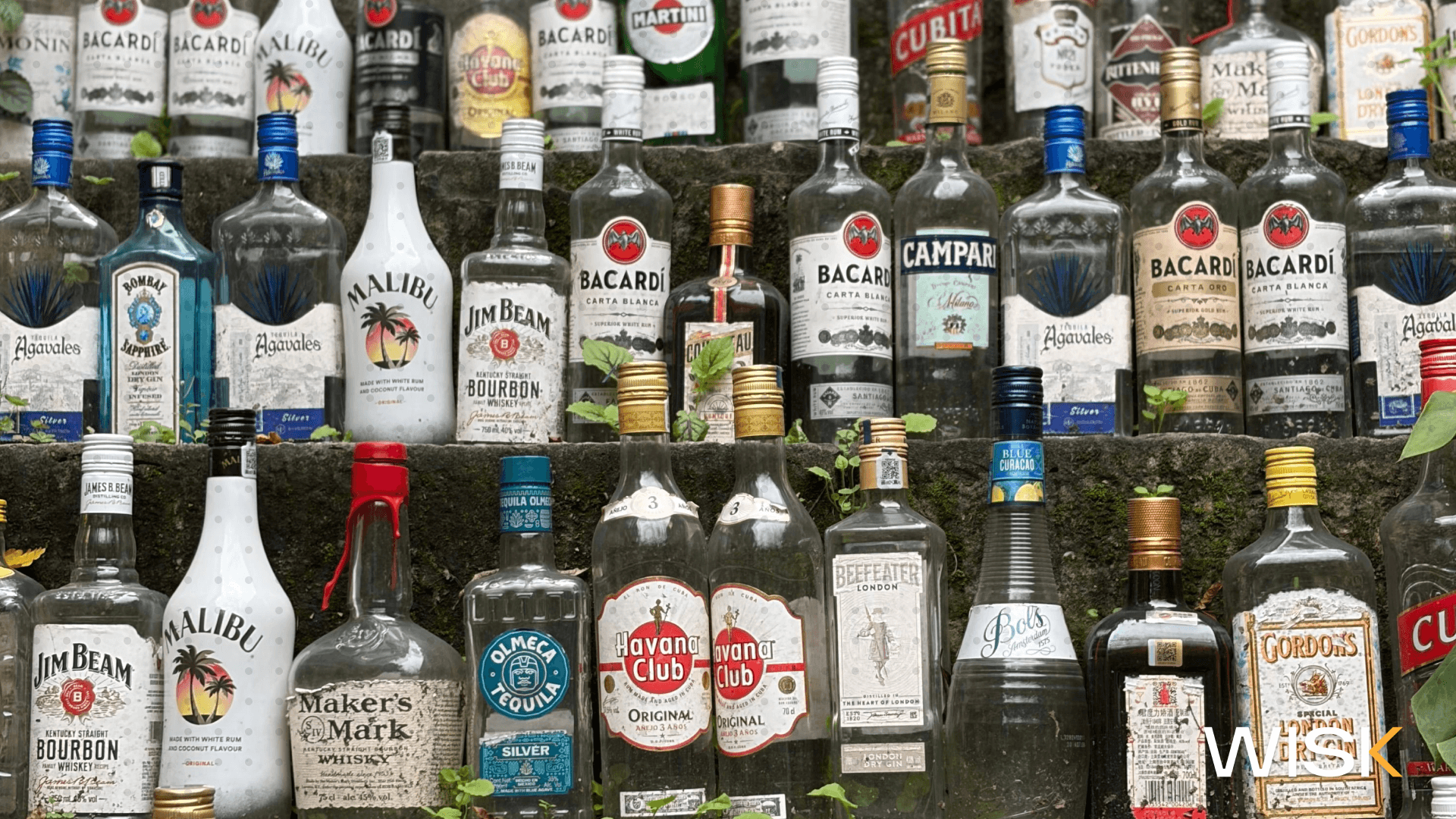
Bacardi leads with 7,741 records, making it the clear frontrunner in spirit additions tracked by WISK.ai across thousands of active items, reflecting its versatility in cocktails and reliability for high-volume venues.
- Real venues prioritize brands that move fast and integrate into multiple recipes without guesswork. Having a massive baseline of Bacardi means operators are heavily investing in rum-based volume programs that require strict variance tracking to remain profitable.
- Jack Daniel's (6,953) and Patrón (6,555) follow closely, showing strong demand for whiskey and tequila staples. These are default "call brands" for consumers. When guests order these by name, they aren't looking for a substitution, which means stockouts on these specific items will actively hurt your nightly revenue.
- Grey Goose (6,356), Absolut (6,347), and others round out the top 10, confirming vodka's enduring pull alongside premium options. Standardizing these exact brands in your recipe costing allows for highly predictable profit margins on high-volume weekend shifts.
Why is the agave category dominating premium spirit additions?
With Patrón (6,555), Don Julio (6,432), and Casamigos (5,268) all sitting in the top ten most added spirits, our data confirms that premium agave is the foundational requirement for modern profitability.
- The sheer volume of Don Julio and Casamigos records indicates venues aren't just stocking Blanco; they are heavily investing in Anejo and Reposado expressions. Consumers are drinking less, but they are drinking better, and they are willing to pay top dollar for recognized agave labels.
- Because the wholesale price of 100% agave tequila can fluctuate rapidly based on supply chain issues, operators must tie their POS directly to their inventory software. If your Patrón Margarita prices don't reflect current invoice costs, your margins are shrinking daily.
- Aged tequilas are expensive to keep sitting on a shelf. Analyzing exactly how fast these bottles move helps you avoid tying up too much cash in your back room. Capital efficiency is critical for maintaining cash flow in the slower winter months.

Which cocktail recipes are driving the highest volume in bars right now?
The Old Fashioned is the number one most created recipe across venues (26), but batched variations of the Negroni (25) and Margarita (15) now make up 30% of the top ten, proving that pre-batching is the definitive 2026 strategy.
- Speed of service is critical right now. When you batch an Infused Mezcal (23 venues) or a Negroni, you're not just saving your bartenders time on a busy Friday night; you are guaranteeing absolute consistency for every single guest that walks through your doors.
- Sitting tied for fifth place with 21 venues logging it as a core recipe, the Espresso Martini is officially a modern classic that requires strict portion control on both the spirit and the coffee components to remain profitable.
- Traditional recipe tracking completely fails when it comes to batching. If your inventory system doesn't account for the yield loss when transferring batches to new containers, your pour cost percentages will always look artificially inflated, making specialized recipe management and costing software essential for accurate profitability.
Which bottle sizes appear most often in venue logs?
750 ml bottles dominate with 781,537 counts, making them the standard for efficiency as confirmed by normalized volume data from WISK.ai.
- 1 L (173,610) and 700 ml (58,369) follow, balancing portability and value. If your point-of-sale system doesn't mathematically differentiate between a 750ml and a 1L pour cost, your depletion data is entirely compromised.
- Cans like 355 ml (12 oz) and 473 ml (16 oz) support high-turnover beer and RTD trends. We are seeing a massive shift toward ready-to-drink cocktails, and venues must account for these distinct packaging formats in their par levels, which is far easier to manage with dedicated bar inventory management software.
- Larger formats (1.5 L, etc.) suit batching and events. According to recent beverage trends, standardizing your bottle sizes with your distributors is one of the fastest ways to yield better tiered pricing.
What mixers do bartenders use most in spirit recipes?
Water tops the list at 438 uses, followed by Simple Syrup (279) and Lemon Juice (175), highlighting foundational building blocks tracked by WISK.ai across spirit-containing recipes.
- Why is water number one? Because when you batch cocktails like Old Fashioneds and Manhattans, you must add water to the batch to account for the dilution that normally happens when stirring with ice. The smartest operators are mathematically calculating their dilution.
- Citrus juices and bitters like Angostura (106 uses) enable classic profiles without complexity. Because bitters are dispensed in dashes, they are notoriously difficult for traditional systems to cost out. You need software that can break down a 200ml bottle into a cost-per-dash metric.
- This keeps recipes simple, consistent, and highly cost-effective for the prep kitchen. Specialty items appear lower, showing restraint in high-volume operations. Smart operators stick to proven cocktail trends by strictly tracking basic yields on their fresh citrus.
Why is automated recipe costing critical for batching programs?
WISK.ai's data shows that batched cocktails represent 30% of the top ten recipes, meaning automated, milliliter-exact recipe costing is required to track bulk ingredients and water dilution accurately.
- When you transition a venue to a batched cocktail program, traditional spreadsheet math breaks down. You are no longer tracking single one-ounce pours; you are tracking massive cambros of blended spirits, syrups, and added water weight, and even a structured bar inventory spreadsheet template quickly shows its limits compared to automation.
- Automated systems allow you to build a "sub-recipe" for your batch, and then attach that batch to a POS button. When a bartender rings in a Negroni, the system automatically depletes the exact fractional amount of gin, campari, and vermouth from your stockroom.
- This level of integration completely eliminates the end-of-month panic where management realizes they have severe variance in their base spirits but cannot figure out which bartender or which cocktail is responsible, reinforcing the principles of disciplined bar inventory control and stock-taking.
The Manual vs. WISK.ai Standard
To truly understand how analyzing this category and volume data impacts your day-to-day operations, let's look at a direct comparison of how these metrics are handled traditionally versus how they are managed through modern automation.
How does WISK.ai automate inventory management and recipe costing?
WISK.ai replaces manual spreadsheets with a database of over 200,000 beverage items and automated barcode scanning, reducing inventory counting time by up to 80% while identifying exact variance down to the milliliter.
You are running a hospitality business, not a data entry firm. When I look at this 2026 data—the sheer volume of Scotch and Whisky being managed, the standardization of the 750ml bottle, the rise of the batched Negroni, and the heavy reliance on foundational mixers—it becomes incredibly clear that manual tracking is no longer a viable business model. Modern bar operators cannot afford to spend six hours on a Sunday manually keying numbers into an Excel sheet that will be outdated by Monday morning's delivery.
By utilizing our native iOS app, Bluetooth scale integrations, and seamless POS syncing, you regain hours of your life back every single week. More importantly, you stop guessing where your liquor went and start seeing exactly how much money your beverage program is actually making in real-time, especially when you pair it with the essential tech tools every restaurant manager needs and benchmark it against the top bar inventory apps available today.
When you know your exact pour costs, you can confidently run promotions, adjust menu pricing, and optimize your back-bar real estate to feature the high-margin agave and whiskey brands that consumers are actually asking for. Stop letting variance, over-pouring, and manual data entry errors dictate your bottom line. Book a demo with WISK.ai today and let our data drive your operational profitability.