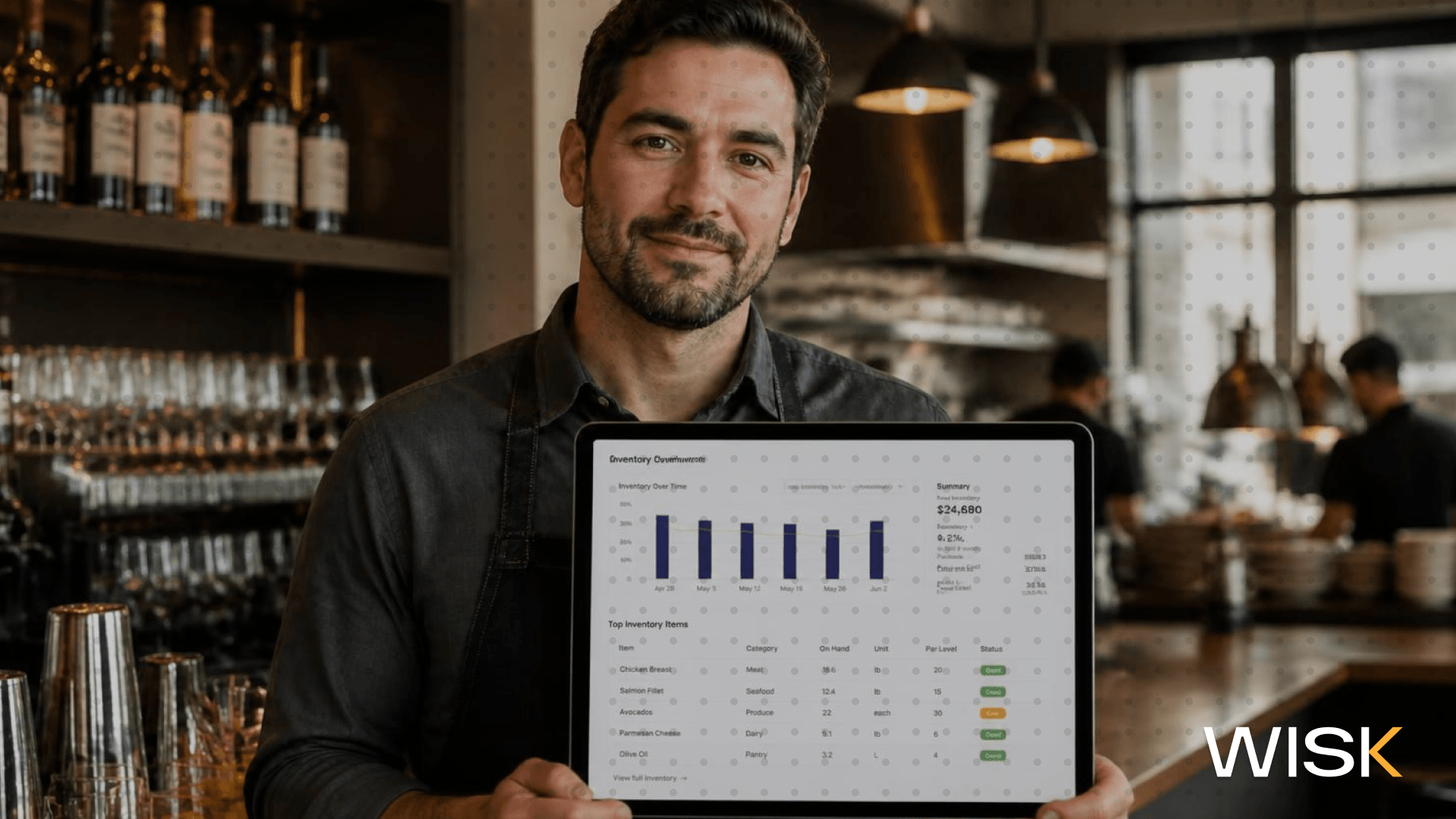
The Bottom Line: Hotel bars and restaurants prevent liquor theft and shrinkage by replacing manual inventory counting with automated systems like WISK.ai, which track theoretical versus actual usage in real-time. By integrating directly with the POS and utilizing Bluetooth scales, WISK.ai exposes exact variances down to the milliliter, typically reducing beverage costs by up to 5% within the first month of implementation.
What is the primary cause of liquor shrinkage in hospitality venues?
The primary cause of liquor shrinkage is undocumented overpouring and unrecorded comps, which silently drain up to 20% of lost beverage revenue in traditional hotel bars and restaurants.
If you run a multi-location operation, you already know that your staff isn't necessarily walking out the back door with cases of Casamigos. The reality of shrinkage is much more subtle. It happens a quarter-ounce at a time. A heavy pour for a regular guest. A spilled shot that never gets recorded. A complimentary drink given to a friend without being punched into the point-of-sale system.
When you rely on end-of-month spreadsheets, these daily operational leaks become entirely invisible until the financial damage is already done. You look at your P&L, see a massive hole in your beverage cost, and have absolutely no idea which shift, which bartender, or which location caused the bleed.
To fix this, you have to shift your perspective. You cannot manage what you do not measure accurately, which is why mastering bar inventory control and liquor stock management is so critical. When you operate blind, the "heavy hand" becomes a cultural standard at your bar rather than an isolated incident. Industry operators often accept an industry average shrinkage rate of 15% to 20% as the "cost of doing business." But in an industry operating on razor-thin margins, accepting a 20% loss on your most profitable inventory is an operational failure. You need a system that captures these granular losses daily so you can course-correct before the end of the month.
How does tracking Theoretical vs. Actual usage stop bartender theft?
Tracking Theoretical vs. Actual usage stops theft by matching every ounce sold in your POS against the exact volume missing from the physical bottle, instantly flagging unaccounted inventory before the shift ends.
Let’s talk about accountability. When your bartenders know that management only checks inventory on the 1st of the month using visual estimates, the perceived risk of giving away a free drink is zero. They know you cannot track a missing ounce of Grey Goose across a 30-day period.
This is where POS Integration & Theoretical vs Actual Usage completely changes the behavioral dynamics behind your bar and highlights the value of a dedicated bar and restaurant inventory management software. Here is how it works in practice:
- The Theoretical: Your Point of Sale (POS) system records that you sold 40 ounces of Tito's Vodka during the Friday night shift.
- The Actual: Your inventory data shows that exactly 48 ounces of Tito's Vodka physically left the bottles during that same timeframe.
- The Variance: You have an 8-ounce discrepancy.
With WISK.ai, this calculation happens automatically. You don't have to pull reports, export CSVs, or run pivot tables. The system pulls the sales data directly from your POS, compares it to your physical inventory counts, and immediately highlights the gap. Once your staff realizes that every single drop is mathematically accounted for, the "free pour" culture stops overnight. You aren't just catching theft; you are actively preventing it by creating an environment where undocumented pouring is immediately visible to management.
Why are instant variance and overpour alerts critical for multi-location operators?
Instant variance and overpour alerts allow multi-location operators to pinpoint specific shifts, locations, or bartenders causing losses in real-time, reducing investigation time by over 80%.
If you are an F&B Director managing five hotel properties or a restaurant group with a dozen locations, you physically cannot be everywhere at once and need to lean on essential tools every restaurant manager needs to keep standards consistent. Your biggest enemy is the time delay between when an error occurs and when you find out about it.
Without automation, variance analysis requires a manager to sit in a back office, cross-reference supplier invoices, POS reports, and messy inventory clipboards, often repeating the same bar inventory management mistakes and fixes month after month. By the time they find a discrepancy, the bartender responsible might not even be on the schedule anymore.
WISK.ai solves this proximity problem through Instant Variance & Overpour Alerts. Instead of hunting for data, the data comes to you.
- Proactive Management: If the Lobby Bar at Location A is suddenly missing three bottles of premium tequila, you receive an automated alert on your phone.
- Targeted Training: Instead of holding a generic, sweeping staff meeting about "watching our pours," you can look at the data and say, "During the Tuesday night shift, we lost 12 ounces of well whiskey. What happened?"
- Standardized Operations: It enforces a standard operating procedure across all your venues. You get a unified dashboard showing exactly which properties are hitting their target pour costs and which are bleeding inventory.

How does accurate recipe costing with yield tracking improve pour cost?
Accurate recipe costing with yield tracking lowers pour costs by factoring in exact preparation waste—ensuring drink prices automatically adjust to protect your target 15-20% profit margin as supplier prices fluctuate.
Most bar managers cost out their cocktail menu once a year. They calculate the price of the spirits, add a rough estimate for juices and syrups, set the menu price, and forget about it. But the market doesn't stay static. Supplier prices shift constantly.
More importantly, a lime does not yield 100% juice. A bundle of mint has stems that get thrown away. If you are not factoring in the waste generated during preparation, your cocktail margins are completely inaccurate, and even a well-structured bar inventory spreadsheet template will only partially cover that gap.
This is where Recipe Costing with Yield Tracking becomes a competitive advantage. When you use WISK.ai, you build your recipes dynamically, applying proven alcohol pricing and cocktail costing strategies instead of guesswork.
- Real-time Cost Updates: When your distributor raises the price of your house gin by $2 a bottle, WISK.ai automatically recalculates the exact cost and profit margin of every cocktail on your menu that uses that gin.
- True Yield Calculations: The system allows you to input the usable yield of your fresh ingredients. If juicing grapefruits only yields 60% usable liquid, the system prices your recipe based on the actual cost of the liquid you use, not the gross weight of the fruit you bought, helping you fully leverage the features included in your WISK subscription pricing plans.
- Menu Engineering: By having accurate, live data, you can confidently lean into dynamic recipe costing strategies. You will instantly see which cocktails are your cash cows and which ones are secretly losing you money.
How do Bluetooth scales replace manual inventory counting?
Bluetooth scales cut inventory time by 80% by instantly calculating remaining liquid weight and syncing directly to the cloud, eliminating the "tenth-ing" guessing game used in traditional visual inventory.
Let’s be honest about traditional bar inventory: it is a universally hated task, especially when you are following a manual step-by-step liquor bottle measuring process. At 3:00 AM, a tired manager walks around with a clipboard, picking up bottles, holding them up to the light, and guessing "0.4" or "0.7" full. This method, known as "tenth-ing," is wildly inaccurate. If you are guessing the volume of a $150 bottle of scotch, a visual error of 0.1 can throw your entire variance report off by hundreds of dollars, especially if you do not know exactly how many ounces are in a 750ml bottle.
To optimize your beverage program, you need to step away from the clipboard and leverage bar inventory technology. Implementing a liquor inventory scale integrated with your bar app plus Detailed Pour Cost Analytics eliminates human error from the equation entirely.
- Precision Measurement: You place a bottle on the scale, scan the barcode using the WISK.ai mobile app, and the system instantly cross-references the exact weight against a global database of over 200,000 beverage items.
- Instant Syncing: It calculates the remaining liquid down to the fraction of an ounce and syncs it instantly to your cloud dashboard. No manual data entry. No reading bad handwriting.
- Operational Speed: What used to take two managers six hours on a Sunday morning can now be completed by one person in less than an hour.
You are giving your managers their time back so they can focus on guest experience and staff training, rather than doing basic arithmetic in a dark liquor room.
What is the final financial impact of automating bar inventory?
Automating bar inventory increases bottom-line revenue by exposing hidden dead stock and eliminating overpouring, typically recovering $5,000 to $10,000 per month for high-volume hospitality venues.
When you pull all of these elements together—the POS integration, the variance alerts, the yield tracking, and the Bluetooth scales—you stop playing defense with your beverage program. You move into an offensive strategy.
Detailed pour cost analytics allow you to optimize your ordering. You will quickly discover bottles that have been sitting on your back bar for a year tying up your cash flow. You can adjust your par levels so you are only ordering exactly what you need to get through the week, freeing up capital.
Ultimately, preventing theft and shrinkage isn't about treating your staff like criminals; it is about providing them with the professional tools they need to operate a highly efficient, profitable business.
Comparison: Traditional Inventory vs. WISK.ai