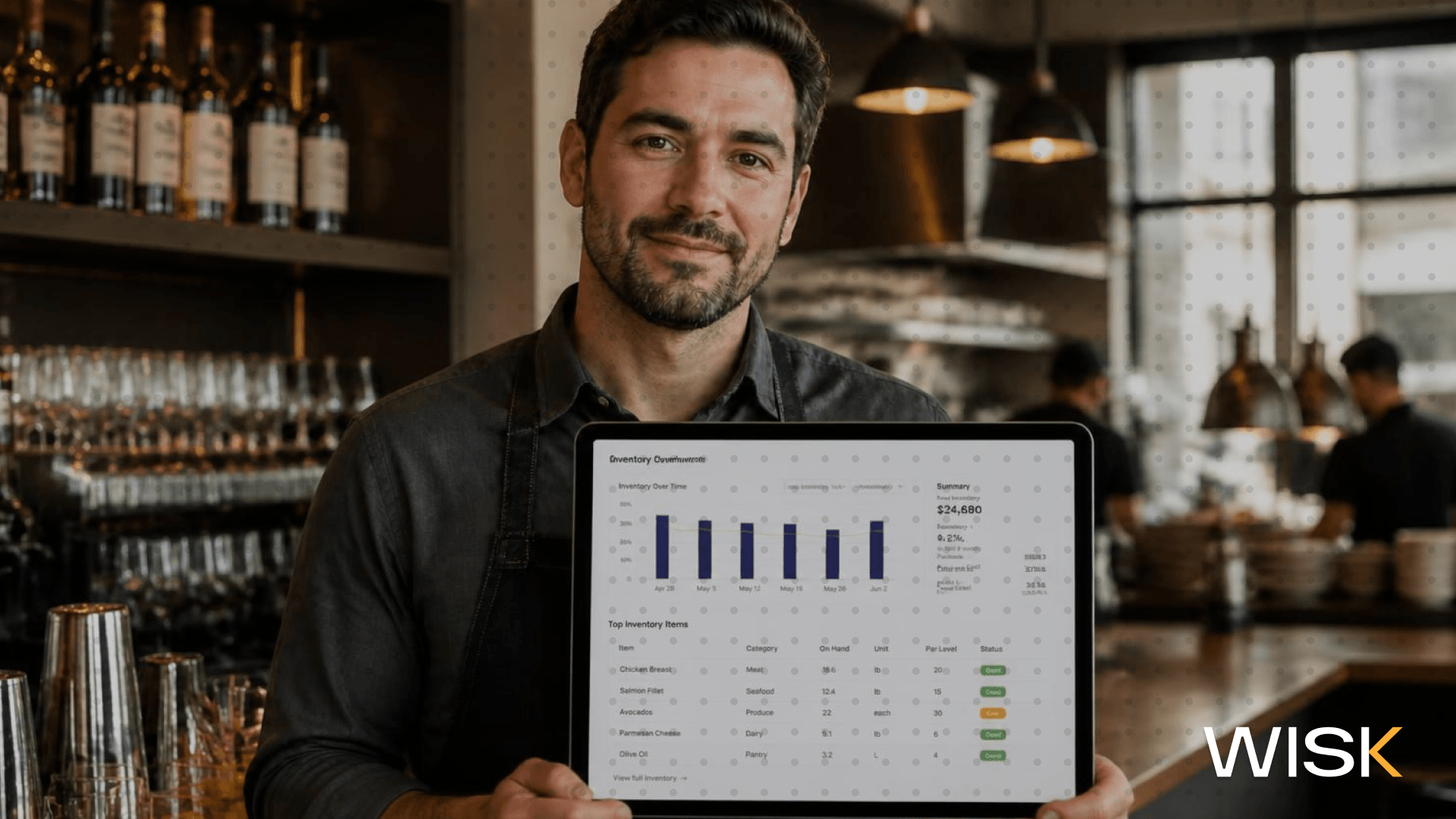
The Bottom Line: The most effective way for hotels to automate F&B inventory is by deploying AI-driven software like WISK.ai that integrates bluetooth scales, barcode scanning, and direct POS syncing. This entirely eliminates manual spreadsheet data entry, cuts average weekly inventory time from over 12 hours to under two hours, and instantly flags costly variances across multiple hotel outlets.
Why does manual hotel beverage inventory take so long and cost so much?
Manual hotel beverage inventory typically consumes 10 to 15 hours of labor each week because highly paid management staff must visually estimate bottle volumes, write counts on clipboards, and manually key that data into spreadsheets across multiple restaurant outlets and banquets.
When F&B Directors and Bar Managers rely on legacy counting methods, they are paying premium salaries for rudimentary data entry instead of addressing underlying bar inventory management issues. The traditional "tenthing" method—where a manager eyeballs a bottle and guesses if it is 0.3 or 0.4 full—is not only wildly inaccurate, but it forces staff to touch every single bottle multiple times. One person calls out the brand, another writes it down, and a third inevitably has to decipher handwriting the next morning to input it into an Excel file.
- Labor Drain: Spending 10 hours a week on inventory equates to over 500 hours a year. At a conservative management rate of $30 per hour, hotels are burning $15,000 annually just to count bottles.
- Data Decay: By the time a manual spreadsheet is completed, audited, and submitted to the accounting department, the data is already days old. You are making purchasing decisions based on historical, often inaccurate, numbers.
- Operational Bottlenecks: Modern systems reverse this drain. Data shows that 89% of hotel operators save significant weekly hours when they replace manual data entry with integrated property management and automated inventory systems. Your team's time should be spent on the floor coaching staff and driving guest experience, not locked in a storeroom with a calculator.
How much money do hotels lose to F&B variance and unrecorded waste?
The industry standard for beverage variance sits between 18% and 24%, meaning hotels routinely lose up to a quarter of their liquid inventory to overpouring, unrecorded comps, spillage, and outright theft.
Variance is the silent killer of hotel F&B profitability, and mastering bar inventory control processes is essential to keep it in check. It represents the gap between the alcohol you purchased and the revenue you actually collected. When you are operating a multi-million dollar beverage program across a lobby bar, pool deck, room service, and banquets, a 20% variance equates to hundreds of thousands of dollars evaporating from your bottom line annually. While a healthy beverage program should maintain a cost of goods sold (CoGS) around 20% to 25%, properties relying on manual counts frequently see their CoGS spike into the low 30s.
- The "Heavy Pour" Problem: A bartender overpouring a signature cocktail by just a quarter of an ounce might seem negligible, but multiplied by 500 cocktails on a busy Friday night, it rapidly destroys your margin, especially when you understand how many ounces or shots are in a 750ml bottle.
- Unrecorded Transfers: In hotels, it is incredibly common for the rooftop lounge to run out of premium vodka and "borrow" three bottles from the banquet storeroom. Without an automated tracking system, those transfers go unrecorded, skewing the CoGS for both departments.
- Margin Erosion: To maintain profitability, industry CoGS standards dictate tight controls. You cannot control what you cannot measure accurately. If you don't know exactly what is missing at the end of every shift, you cannot implement the necessary training or operational guardrails to fix it.
How does Mobile Barcode Scanning + Bluetooth Scale Integration speed up bar inventory?
Combining Mobile Barcode Scanning + Bluetooth Scale Integration accelerates inventory speeds by up to 80% because staff simply scan a bottle's barcode with their phone and place it on a connected scale to record volume to the exact fraction of an ounce.
The days of squinting at a bottle of liquor and guessing the remaining liquid volume are completely obsolete when you invest in a liquor inventory scale integrated with software. By utilizing smart hardware and mobile technology, WISK.ai completely removes human error and guesswork from the inventory equation. The workflow is incredibly direct: a staff member opens the app on their smartphone, scans the barcode on the back of the bottle, and sets it on the Bluetooth scale. The software instantly recognizes the exact brand, bottle size, and specific gravity of the liquid, logging the exact remaining volume in less than two seconds.
- Fractional Accuracy: Bluetooth scales measure down to the exact gram. This means you know precisely how many fractional ounces are left in a bottle of rare scotch, eliminating the financial discrepancies caused by visual estimation.
- Database Power: Because the system is tied to a massive database of over 150,000 global beverage items, your staff does not have to manually input new products, create SKUs, or look up bottle weights, unlike traditional methods that rely on manual liquor bottle measurement steps.
- Delegation: Because the process is so accurate and foolproof, F&B Directors no longer have to do the counts themselves. You can confidently delegate inventory scanning to junior bartenders or barbacks, knowing the technology will guarantee flawless accuracy.
How do Real-Time Multi-Outlet Inventory Dashboards improve F&B operations?
A Real-Time Multi-Outlet Inventory Dashboard centralizes stock levels across the lobby bar, rooftop lounge, room service, and banquets into a single view, preventing redundant ordering and reducing carrying costs by 5% to 10%.
Hotels are notoriously complex ecosystems. When operations are siloed, each outlet manager tends to hoard inventory to protect their own operation, leading to massive amounts of capital tied up in dead stock. The rooftop bar might urgently order three cases of Casamigos tequila from a distributor, completely unaware that the basement banquet hall has five cases sitting untouched from a canceled corporate event. The Real-Time Multi-Outlet Inventory Dashboard solves this instantly.
- Cross-Outlet Visibility: F&B Directors can log in from their phone and see the exact par levels and stock counts of every single bar and storeroom on the property simultaneously.
- Internal Transfers Over External Orders: Before placing an expensive order with a vendor, managers can initiate digital internal transfers. The system automatically deducts the inventory from the banquet hall and adds it to the rooftop bar's CoGS, keeping accounting perfectly balanced without spending new money.
- Dynamic Par Levels: The dashboard utilizes historical sales data to recommend dynamic par levels for each specific outlet, effectively replacing static par inventory sheet setups. This ensures you are only carrying the inventory you actually need to meet demand, freeing up cash flow for other areas of the hotel.

Why is Offline Mode for Cellars & Basements essential for hotel inventory counts?
Offline Mode for Cellars & Basements allows F&B staff to scan and weigh bottles seamlessly in dead-zones without Wi-Fi or cellular service, automatically syncing the data the moment the device reconnects to the network.
Hotel architecture is inherently hostile to modern cloud technology. The most valuable inventory—fine wines, premium spirits, and bulk kegs—is almost always stored in sub-basements, concrete bunkers, or reinforced cellars where Wi-Fi signals and cellular data absolutely cannot reach. If your inventory software requires a persistent internet connection to function, your staff will spend half their shift watching a loading screen or walking up two flights of stairs just to sync a spreadsheet.
- Uninterrupted Workflow: With Offline Mode for Cellars & Basements, the WISK.ai app stores the entire item database and barcode registry locally on the mobile device. Staff can count an entire concrete storeroom at lightning speed without a single interruption or dropped connection.
- Data Integrity: Once the inventory count is complete, the staff member simply walks back into the lobby or an area with a Wi-Fi connection, where inventory management software for bars and restaurants automatically syncs the data. The app instantly executes a background sync, pushing all offline data directly into the central cloud dashboard without any manual prompting.
- Staff Frustration: Eliminating technology friction is key to staff retention. Forcing your team to use software that constantly crashes in the basement leads to abandoned counts, skipped items, and fabricated numbers. Offline capability guarantees compliance.
How does Automated Variance Reporting (Theoretical vs Actual) eliminate shrinkage?
Automated Variance Reporting (Theoretical vs Actual) integrates directly with the hotel's POS system to instantly compare the exact volume of alcohol sold against the physical volume missing, pinpointing the specific items and shifts responsible for shrinkage.
You cannot fix a leak if you don't know where it is coming from. Automated Variance Reporting (Theoretical vs Actual) bridges the gap between your physical inventory and your point-of-sale data. The logic is impenetrable: if your POS system registers that you sold 20 one-ounce pours of Tito's Vodka, but the Bluetooth scale confirms that 30 ounces physically left the bottle, you have a 10-ounce variance. WISK.ai does this math automatically for every single item in your hotel, instantly generating a variance report the moment inventory is completed, leveraging its bar inventory software capabilities.
- Actionable Data: Instead of a vague feeling that "liquor costs are high this month," F&B Directors receive a line-by-line report showing exactly which brands are missing. If you are missing $400 of premium tequila but your well vodka is perfectly balanced, you know exactly where to investigate.
- Targeted Training: Variance reports allow you to identify whether an issue is isolated to a specific outlet or a specific shift. If the lobby bar always shows high variance on Friday nights, you can shadow that shift, check jigger sizes, and retrain bartenders on standardized pour metrics.
- Psychological Deterrent: When staff know that a system is tracking inventory down to the fraction of an ounce and comparing it directly to the POS, casual theft, unauthorized free drinks, and sloppy pouring evaporate almost overnight. The mere presence of the technology enforces accountability.
What is the financial ROI of switching from manual spreadsheets to WISK.ai?
Hotels switching from manual spreadsheets to WISK.ai typically achieve full ROI within 60 days by recovering 10+ hours of weekly management labor, reducing beverage CoGS by 3% to 7%, and cutting inventory shrinkage by up to 80%.
Upgrading hotel F&B technology is not an operational expense; it is a rapid-yield revenue recovery strategy. The financial mechanics are straightforward. If you pay a manager $30 an hour, saving 10 hours a week puts $1,200 a month directly back into your labor budget—savings that compound further when you deploy essential restaurant management tools alongside inventory automation. Furthermore, if your hotel purchases $50,000 of beverage inventory monthly, utilizing automation to shave just 5% off your CoGS through tighter variance control yields an additional $2,500 in pure monthly profit.
The data below illustrates exactly how the traditional manual method drains hotel resources compared to an automated AI system, echoing many best practices for managing inventory and orders in hospitality operations.
By eliminating the manual data entry pipeline, hotels stop paying managers to do administrative grunt work. The immediate reduction in shrinkage, combined with the real-time visibility into multi-outlet stock, transforms hotel F&B inventory from a dreaded weekly chore into a highly optimized, profit-generating machine.