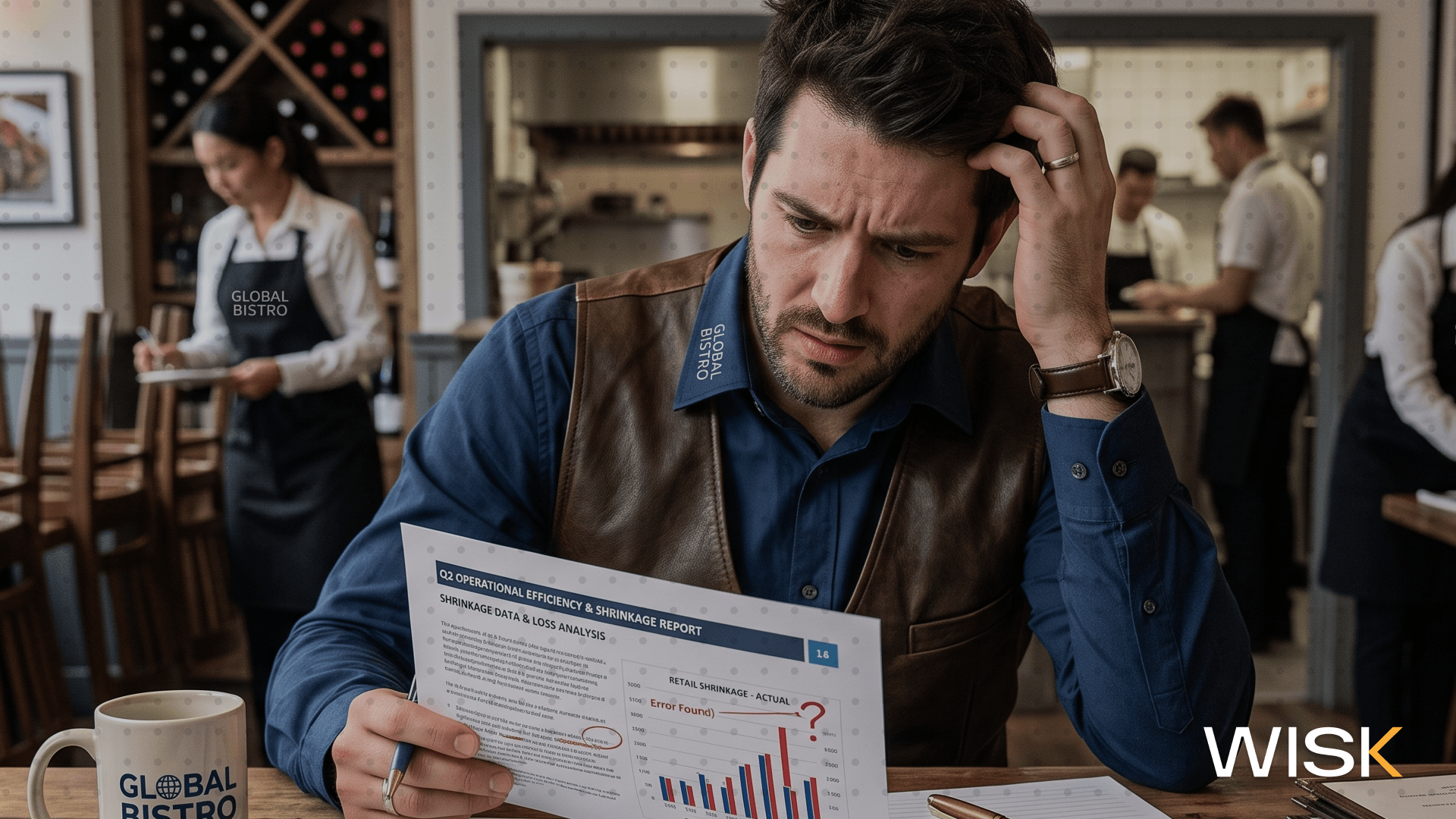
The Bottom Line: You can't control tariff policy — it has changed four times in the last six months — but you can control how fast you see the damage on your invoices. Restaurant owners, controllers, and F&B managers who track supplier prices at the item level, recalculate COGS against current invoice costs, and run weekly variance reports catch tariff pass-through in days instead of at month-end, when a full period of margin is already gone. WISK is built for that job: purchasing and supplier price tracking, live Cost of Goods Sold, and variance reports that separate price inflation from usage loss.
How much have tariffs actually raised restaurant food and beverage costs?
More than two-thirds of operators (68%) said tariffs drove up their food or beverage costs in 2025, and 87% reported further food cost increases in the first half of 2026. Average food costs now run more than 35% above pre-pandemic levels.
The scale here is worth sitting with. According to the National Restaurant Association's 2026 State of the Industry report, 82% of operators saw higher average food costs last year — and only 42% turned a profit. Restaurant365's mid-year survey of more than 420 operators found 78% expect costs to keep climbing through the end of this year.
For a controller, that combination is the whole problem in two numbers: costs up almost everywhere, profitability at well under half of operators. There is no cushion left to absorb a surprise.
Which categories are getting hit hardest right now?
Beef, coffee, imported wine, seafood, Mexican produce, and anything packaged in an aluminum can are carrying the most pressure — coffee alone has run roughly 20% above year-ago prices. Before the November 2025 exemptions, the Tax Foundation estimated that 74% of the $221 billion in U.S. food imports faced tariffs, with spirits, liqueurs, coffee, fish, and beer among the most affected.
Here's where it lands on a real order guide:
- Beef is squeezed by tight domestic herd supply on top of trade disruption, so relief on duties doesn't automatically mean relief on price.
- Imported wine has been the sharpest beverage story. Shelf prices on some brands climbed 5–12% during 2025, and wholesalers have been open about the fact that pass-through pressure is still building as pre-tariff bulk inventory runs out. Spirits producers have had more margin room to absorb it than wine producers, but only if they're disciplined about alcohol pricing and cocktail costing.
- Packaging and canned beverages get hit indirectly. Section 232 steel and aluminum duties never lapsed with the rest, so cans, foil, and takeout containers keep costing more.
- Produce from Mexico and citrus categories are absorbing both weather and trade effects at once.
If you run a beverage-heavy concept, this is your line item. A 10% increase on a wine list that represents 30% of your purchasing is not a rounding error, especially when you're also working on tactics to increase bar sales.

Why can't operators just raise menu prices anymore?
Only 52% of operators raised menu prices in the first half of 2026 — down from 66% at the start of the year, and the lowest figure in three years. Not because costs eased, but because guests stopped absorbing it.
Menu pricing was the default lever for four straight years, and it's close to tapped out:
- Around 90% of full-service operators raised prices last year. Whatever headroom existed has largely been used.
- Traffic is soft. Raising prices into a traffic decline can shrink revenue rather than protect it, which is why pairing cost control with strategies to increase restaurant sales matters more than ever.
- 55% of operators said they'd cut headcount if conditions soften further — which tells you where the pressure goes next when pricing stops working.
The operators holding margin right now are the ones going after cost precision instead of price increases, often by building a stack of essential restaurant management tools that tighten controls without beating up the guest. That's a slower, less satisfying lever. It's also the one that doesn't cost you guests.
What is tariff pass-through actually costing your operation?
Most operators can't answer this in dollars, which is why it goes unaddressed for months. Run your own numbers below — you need four figures off your last purchase summary.
Do this before your next supplier conversation, not after. Walking into a distributor meeting knowing that your exposure is $61,000 a year changes the conversation entirely from walking in with a feeling that things have gotten expensive.
What should you track instead of tariff headlines?
Track your own landed invoice costs weekly, because the policy changes faster than any purchasing plan can adapt. The IEEPA tariffs were struck down in February, a temporary global surcharge replaced them within days, a trade court struck that down in May, it expired by statute on July 24, and a new Section 301 program covering roughly 60 economies took its place the same day.
That's four regime changes in six months, plus a 50% duty on Canadian goods including alcohol and dairy announced for August 19. No F&B manager can build a purchasing strategy on that. But your invoices are always current, which makes them the only reliable signal you have.
What that looks like in practice:
- Item-level price history per vendor. Not "produce is up 8%" — you need to know that one item from one supplier moved 14% on a specific date, and pair that with inventory and order management best practices so you actually act on the signal.
- COGS recalculated against current costs. If your recipe costs still use spring pricing, every margin number you're reporting is fiction — this is where recipe management and real-time recipe costing take guesswork out of the numbers.
- Country-of-origin awareness on your top 20 spend items. Duties are origin-specific, so this is what tells you whether a switch is even possible.
How do variance reports catch tariff damage before your P&L does?
A variance report compares what you should have used against what you actually used, which is the only way to tell a price increase apart from a pour or portion problem. If you count monthly, you're running 30 days blind and mixing both problems into one number you can't act on.
This distinction matters more under tariffs than it ever did in a stable market. When food cost jumps two points, there are two completely different explanations:
- Your costs went up. The fix is purchasing — renegotiate, switch origin, adjust the recipe or the price.
- Your usage went up. The fix is operational — retrain pours, tighten portions, address waste or shrinkage.
Treat a price problem as a training problem and you'll frustrate your team while the margin keeps leaking. Treat a usage problem as a price problem and you'll raise menu prices you didn't need to touch. WISK's variance reports split them, item by item, so you're working on the right one.
What's the 30-day playbook for a controller or F&B manager?
Four moves, in this order, and none of them require a new supplier contract.
- Week one — establish the baseline. Pull 90 days of invoices and rank your top 20 items by total spend. That list is usually 60–70% of your purchasing.
- Week two — find the movers. Chart the unit cost of each of those 20 items over the same period. You're looking for step changes, not gradual drift.
- Week three — go item by item with your reps. Ask for the reason behind each specific increase. Ask what the domestic or alternate-origin equivalent costs. Some increases hold; some are negotiable, and you won't know which until you name them.
- Week four — reprice surgically and count weekly. Adjust only the recipes that actually lost margin, then move to weekly counting so the next shift shows up in days rather than at month-end.
How does WISK help restaurants hold margin when tariffs move?
WISK tracks supplier prices at the item level, keeps COGS current against your real invoices, and delivers variance reports that tell you whether you have a purchasing problem or a pour problem — particularly powerful if you're fighting bar inventory management issues alongside tariff pressure. Counts run up to 80% faster, so weekly inventory becomes something one person can actually sustain, or you can start with a free bar inventory spreadsheet to get your process under control — and a database of over 200,000 items means you're not rebuilding your product list every time a distributor swaps a SKU. Tariff policy will keep moving. Your visibility into what you're paying shouldn't.
See what WISK finds in your first count — book a demo.