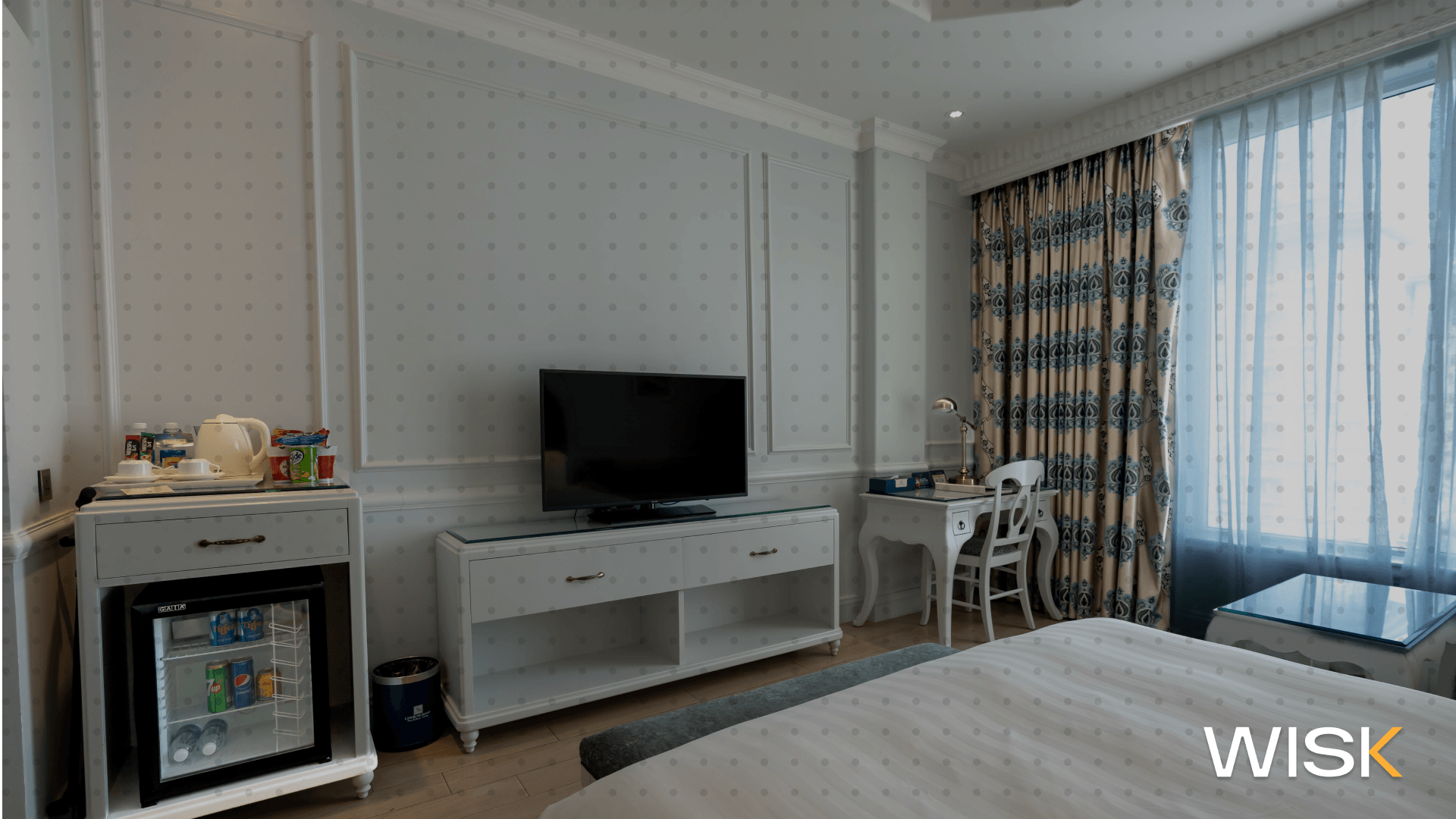
The Bottom Line: Choose a system that tracks depletion at the unit level, sets par levels per location, and reconciles against POS sales in real time — because a canned cocktail sitting in room 812 is a SKU with a contribution margin, not a hospitality gesture. WISK handles this with real-time Sales & Depletion Reporting, Multi-Location Par Levels, and Inventory Management that cuts counts from a full shift to a few clicks, so hotel F&B directors and revenue managers can decide which room tiers get RTDs based on actual margin data instead of instinct.
Why Are Hotels Suddenly Treating RTD Cocktails as a Real Minibar Revenue Line?
Because RTDs deliver cocktail-level margin without cocktail-level labor. The category is forecast to hit US$40 billion by 2027, with cocktails and long drinks taking a quarter of RTD volume share — and one 300-room city hotel lifted minibar revenue per occupied room from $1.80 to $2.10, a 16% uplift, by rebuilding its assortment around what guests actually bought.
The math changed, not the guest. A canned Negroni needs no bartender, no glassware, and no pour cost variance — one barcode, one landed cost, one price. It's the first minibar item in years a revenue manager can model as cleanly as a room type.
What we're seeing hotels do with it:
- Tiering the assortment. Standard rooms get two RTD facings; club and suite tiers get four to six at a higher price point, because those guests convert far better.
- Bundling it pre-arrival. "Arrival cocktail kit, $28" attaches better than a generic F&B credit, and it pre-sells inventory you've already paid for.
- Reporting contribution margin per can, not per department. Minibar stops being a cost center hiding inside rooms and becomes a line item with its own P&L.
The IWSR's RTD category forecast helps justify the assortment spend internally: premium-plus RTDs posted double-digit volume growth in seven of ten major markets, and up to 25% of RTD drinkers will pay more for a spirit-based can. Your suite tier is exactly that buyer.
What Should Hotel F&B Directors Look For in Restaurant Inventory Management Software?
Four non-negotiables: POS integration, real-time depletion, multi-location par levels, and OCR invoice capture. Systems that deliver all four cut cost of goods sold by 3% to 5% and save up to 100 manual hours per month — the single biggest driver of ROI in restaurant inventory management software.
Most inventory platforms were built for a back-of-house walk-in, not 300 minibars scattered across 14 floors. When you're evaluating inventory management systems for restaurants and hotel operations together, the filter is whether the software treats a room as a countable location, and whether it supports best practices for managing your inventory and orders.
Here's the short list of what actually matters:
- POS integration. Without it you have inventory sheets, not inventory tracking. Real-time depletion syncs sales data to stock so availability updates instantly.
- OCR invoice processing. Modern restaurant inventory software reads vendor invoices and flags price discrepancies — live vendor pricing is how you catch a distributor quietly moving your landed cost from $4.10 to $4.60 a can.
- Mobile counts. Your attendant is on a cart, not at a desk. If counting inventory requires a laptop, adoption dies in week two.
- Multi-location support from day one. Retrofitting it later is a re-implementation, not an upgrade.
Pricing for credible restaurant inventory management software starts around $199 per month. Anything materially cheaper is usually a spreadsheet with a login, not a true inventory management software for bars and restaurants.

How Do You Calculate Contribution Margin Per Can Across Room Tiers?
Contribution margin per can = menu price − landed cost − restock labor − shrink. At a $16 menu price, a $4.10 landed cost, $0.90 in restock labor and 6% unbilled shrink, you clear roughly $10.04 per can — a 63% contribution margin, roughly double what a comparable in-room snack returns.
That number is the whole argument — and almost nobody can produce it on demand, because landed cost lives in accounting, restock labor lives in housekeeping, and shrink lives nowhere until someone runs a variance report.
Two things to watch when you model it:
- Shrink isn't theft alone, but a lot of it is. Industry estimates put 75% to 85% of restaurant theft on employees, and unbilled minibar consumption behaves the same way — a variance problem that only surfaces when theoretical usage is compared against actual usage.
- Restock labor scales with tier, not volume. A suite with six facings and a 40% capture rate costs less per can to service than a standard room with two facings and an 8% capture rate.
Run your own numbers below — tier, occupancy, and pricing in; contribution margin per can and a recommended par level out.
[INTERACTIVE EMBED — place wisk-rtd-margin-calculator.html here]
How Does Manual Minibar Tracking Compare to Automated Inventory Management?
Manual clipboard counts give you a monthly snapshot with no variance detection. Automated inventory management gives you real-time inventory values, automated reorder points, and per-can margin — and cuts food waste and shrink by 4% to 10% while reducing count time by up to 80%. For bar outlets, that automation usually starts with investing in a liquor inventory scale integrated to your system.
Here's the side-by-side to bring to your next ownership review:
The costliest gap is row four. A single property-wide par guarantees you're overstocked in standard rooms and stocked out in suites at the same time — and a suite stockout costs you the $16 sale and the review.
How Do Multi-Location Par Levels Work Across Room Tiers and Properties?
Multi-Location Par Levels let you set a distinct minimum and reorder point for every countable location — floor, tier, outlet, or property — and trigger purchase orders automatically when stock drops below par. Operators using automated reordering hold four to six inventory turns per month instead of sitting on dead stock.
Treat each room tier as its own micro-outlet with its own consumption rate. That's not a metaphor; it's how the system should be configured, just as a high-volume lobby bar benefits from dedicated bar inventory management software.
- Standard tier: low capture, two facings, weekly restock. Par set tight so you're not tying up cash in cans that sit for 40 days.
- Club/executive tier: moderate capture, four facings, twice-weekly restock.
- Suite tier: highest capture and price point, six facings, restock on departure. Stockouts hurt most here, so par carries the biggest safety buffer.
For multi-location operators, the same logic rolls up. Centralized vendor pricing and inventory reporting is what lets a regional director see that Property A pays $0.50 more per can than Property B — invisible when each property keeps its own inventory sheets.
How Does Sales & Depletion Reporting Connect Cans to Pre-Arrival Upsells?
Sales & Depletion Reporting matches every unit consumed against POS sales data in real time, so you can attribute revenue to a specific room tier, rate plan, or pre-arrival bundle — and see within days whether a $28 arrival kit is cannibalizing your $16 à la carte can or expanding total spend.
This is value F&B systems usually can't provide. Depletion data gives you sales velocity by tier; sales velocity tells you which bundle to push and to whom.
- Bundle testing with a control group. Push the arrival kit to two tiers, hold one back, compare contribution per occupied room after 30 days.
- Assortment pruning. Historical data reveals which SKUs move. Most properties carry two or three cans that haven't turned in a quarter.
- Seasonal forecasting. AI-based sales forecasting predicts purchasing needs from consumption rates — which matters when July occupancy runs 30 points above February.
The pressure to find margin isn't hypothetical. The National Restaurant Association's 2026 State of the Restaurant Industry found 42% of operators weren't profitable and more than 9 in 10 cited food, labor, and insurance as significant challenges. Ancillary lines with 60%+ contribution margins aren't a nice-to-have this cycle.
What Should Revenue Managers Ask Before Signing a Restaurant Inventory Software Contract?
Ask five questions: Does it integrate with our existing POS? Can it treat a guest room as a countable location? Does it handle multiple packaging units? What does initial setup actually take? And can it report contribution margin without an export to Excel?
Choosing an inventory system depends primarily on your number of locations and your existing POS integrations. Everything else is negotiable.
- Multiple packaging units matter more than vendors admit. You buy by the case, stock by the can, and sell by the four-pack. If the platform can't convert cleanly between all three, your cost of goods sold is wrong every month — and your recipe management and costing will never be accurate across outlets.
- Initial setup is the real cost. Budget for item list build, recipe costing for your bar outlets, and vendor onboarding. A good implementation team does this with you; a bad one emails you a template — and leaves you to assemble the rest of the essential tools every restaurant manager needs on your own.
- Recipe management still matters. Buy one platform for the whole beverage program — your lobby bar needs automated recipe costing that updates pour costs as prices move, and front-of-house leaders still need practical tips to increase bar sales once the margins are in place.
Practical benchmark: hotels running optimized minibar programs see ancillary revenue increases in the low-to-mid teens versus static assortments, plus double-digit drops in disputed charges once consumption is tracked systematically. Both depend on inventory data a clipboard can't give you.
How Does WISK Help Hotels Run RTD Minibars as a Managed Revenue Line?
WISK gives hotel F&B directors and revenue managers unit-level Inventory Management, real-time Sales & Depletion Reporting, and Multi-Location Par Levels in one platform — so every can has a landed cost, a par level, a tier, and a contribution margin you can defend in an ownership meeting.
You get inventory counts in a fraction of the time, variance flagged continuously instead of at month-end, purchase orders triggered automatically against par, and per-tier reporting that tells you which rooms should carry RTDs and at what price. That's the difference between a minibar you restock and a revenue line you manage.
Ready to see what your RTD program is actually earning per can? Book a WISK demo and we'll model your contribution margin by room tier using your own numbers.