
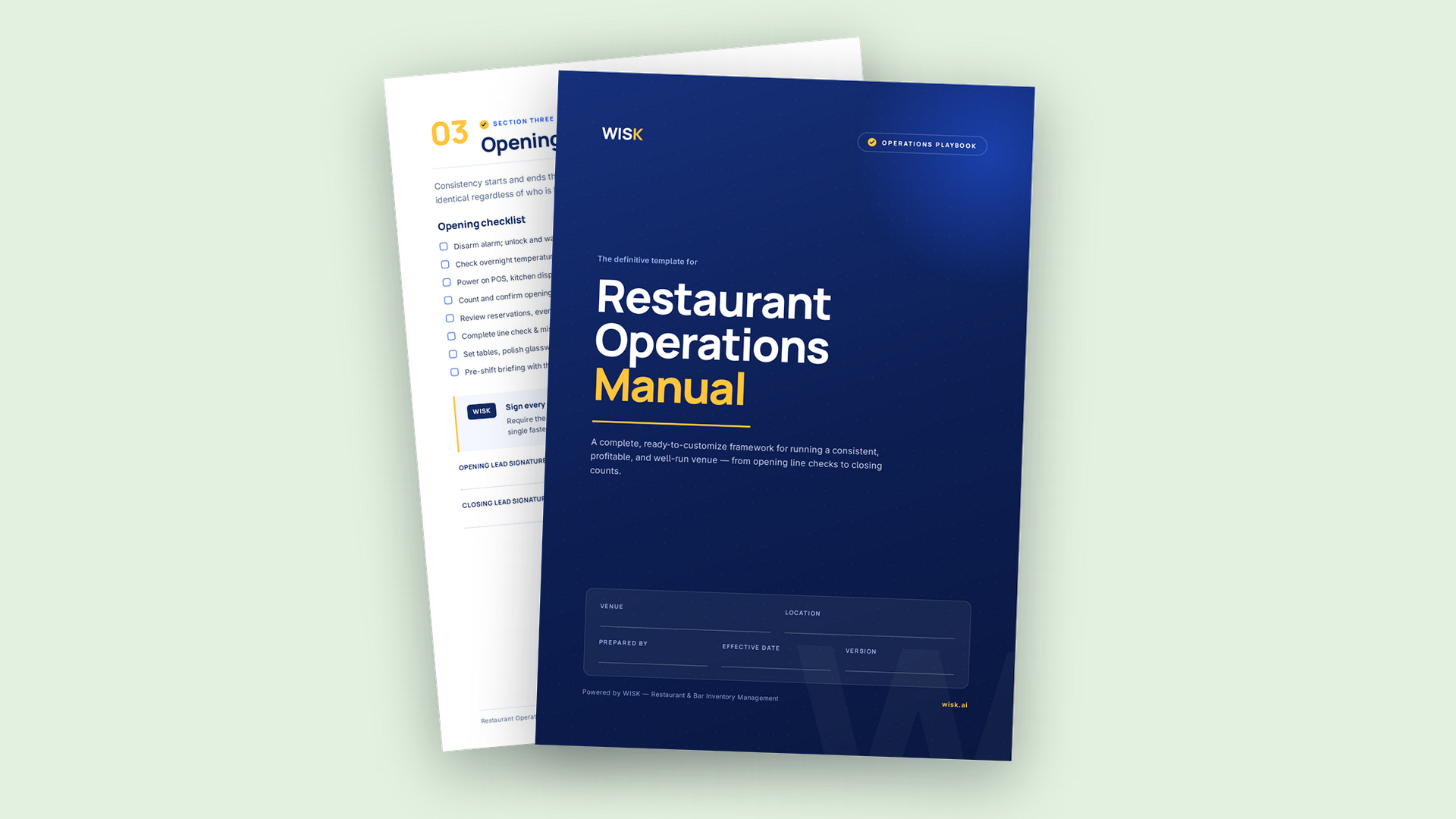
What's inside?
- Twelve operational sections — team structure and reporting lines, opening and closing checklists, front- and back-of-house standards, food safety and HACCP temperature logs, inventory and par management, cost control and COGS, cash handling, and emergency protocols — each built to be adapted to your venue.
Standardize Every Shift With This Operations Manual
A restaurant operations manual is a documented system of procedures, standards, and responsibilities that governs daily service. It converts institutional knowledge — usually held in one manager's head — into a repeatable process any team member can execute.
Inconsistency is where margin quietly disappears. Portioning drift, over-pouring, and unrecorded prep yields all widen the gap between theoretical and actual usage; in high-volume bars, beverage variance commonly runs 18–24% without controls, and food and beverage COGS typically sits at 28–35% of sales. A written standard is the control layer — it defines how a task is done before the result reaches your P&L.
What Should a Restaurant Operations Manual Include?
At minimum, it should define four things: who is responsible (roles and reporting lines), how each shift opens and closes (checklists), what "correct" looks like (service, kitchen, and safety standards), and how the numbers are controlled (inventory, COGS, and cash procedures). This template structures all four, so nothing operationally critical lives only in memory.
If you run more than one location, document the manual once and deploy it across every unit — standardization is what makes a multi-unit operation auditable. Build in the procedures you will need at scale, not only the ones you run today, so the document grows with the operation instead of being rewritten after every hire.
The best operations manual is not the longest one. It is the one your team follows on every shift — documented clearly enough that consistency no longer depends on who is working.


.svg)