En résumé : Les erreurs d'intégration les plus critiques pour les nouveaux gérants de bar tournent autour des processus manuels, du manque de formation standardisée et des données déconnectées, ce qui peut coûter à un établissement jusqu'à 40 heures par mois en travail administratif gaspillé. En tirant parti de l'inventaire automatisé, du suivi dynamique des écarts et des ressources de formation intégrées de WISK.ai, les directeurs de boissons peuvent réduire le temps d'intégration de 80 % tout en établissant des normes opérationnelles immédiates et très rentables.
Pourquoi le fait de ne pas standardiser les procédures d'inventaire est-il une erreur d'intégration critique ?
Permettre aux nouveaux gérants de bar d'utiliser des méthodes d'inventaire incohérentes et non standardisées entraîne une marge d'erreur de 15 à 20 % dans les décomptes de stock, ce qui conduit à des coûts des marchandises vendues (CMV) inexacts et jusqu'à 8 heures de temps de recomptage gaspillé chaque semaine.
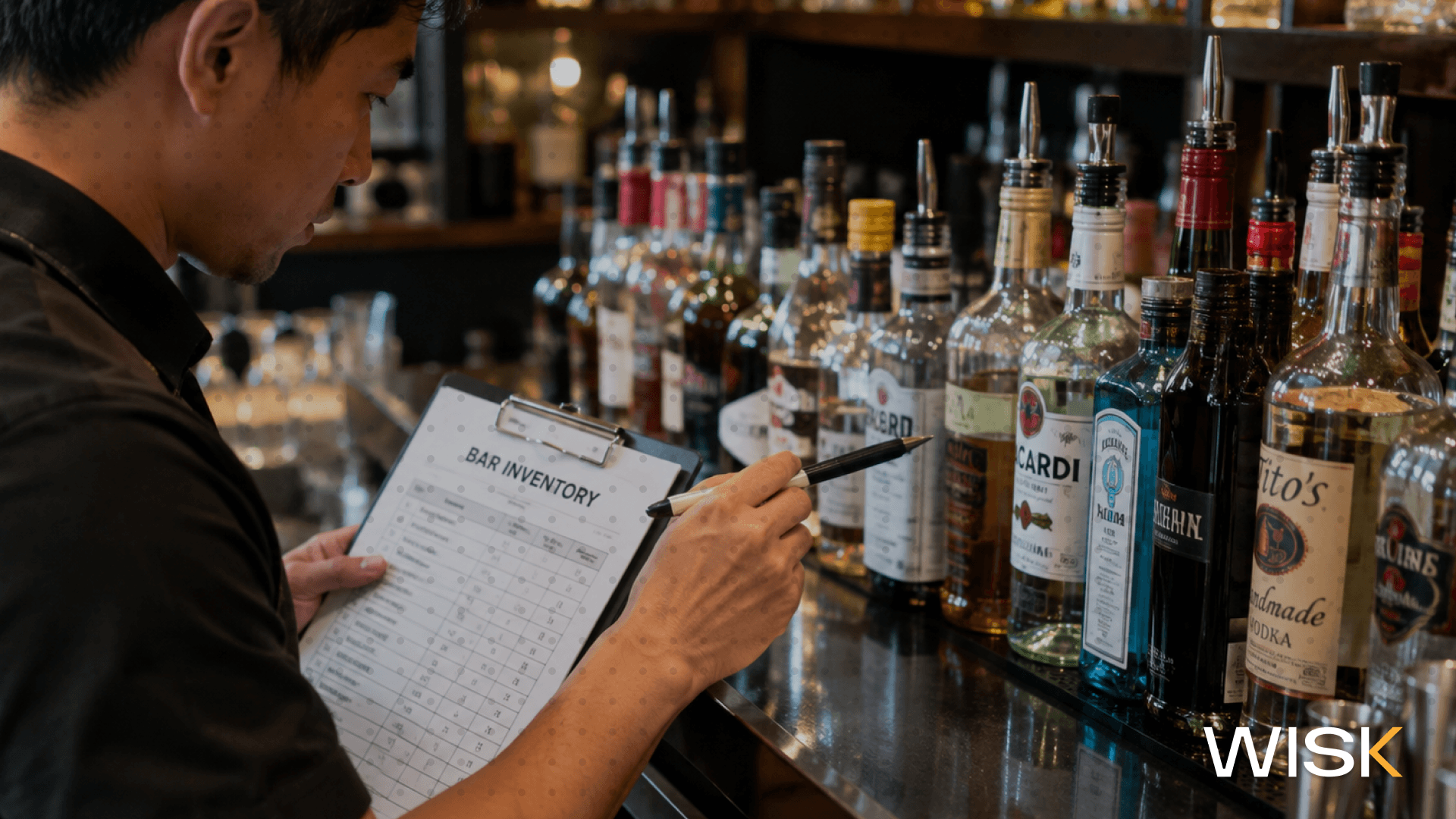
Lorsque vous embauchez un nouveau superviseur de bar, ils apportent souvent leurs propres habitudes de comptage héritées — comme estimer les niveaux des bouteilles à l'œil ou utiliser différentes unités de mesure — de leurs emplois précédents, ce qui va à l'encontre des pratiques structurées de contrôle des stocks de bar qui protègent vos marges.
- Données de référence corrompues : Si un gérant compte par dixièmes et que votre nouveau gérant compte par quarts, vos données de référence sont instantanément corrompues.
- Main-d'œuvre gaspillée : Nous voyons des opérateurs payer des heures supplémentaires simplement parce qu'un nouveau gérant a dû recompter toute la cave à liqueurs après un audit de fin de semaine bâclé.
- La solution : Vous devez établir une source unique de vérité dès le premier jour. En standardisant via un logiciel de gestion des stocks pour bars et restaurants qui nécessitent des mesures numériques précises (comme l'utilisation d'une balance Bluetooth ou d'un curseur visuel standardisé), vous éliminez les approximations et les alignez immédiatement sur votre norme opérationnelle.
Comment le fait de négliger d'examiner les rapports d'écart historiques met-il les nouveaux managers en situation d'échec ?
Ne pas former les nouveaux managers sur les rapports d'écart historiques les aveugle aux schémas de gaspillage et de vol existants, augmentant la probabilité que les pertes de boissons inexpliquées persistent à un taux moyen de 20 % dans l'ensemble du bar.
Vous ne pouvez pas réparer une fuite si vous ne savez pas où les tuyaux sont cassés. Mettre un nouveau manager en poste sans lui montrer où votre bar a traditionnellement perdu de l'argent, c'est lui rendre un très mauvais service.
- Vous devriez vous asseoir avec vos nouvelles recrues dès la première semaine pour examiner les rapports d'écart les plus récents de votre établissement et passer en revue les problèmes et solutions courants de gestion des stocks de bar afin qu'ils reconnaissent immédiatement les schémas problématiques.
- Montrez-leur exactement quels spiritueux à fort volume ou bières pression sont constamment manquants.
- Cela change immédiatement leur état d'esprit, passant d'observateur passif à résolveur de problèmes actif. Cela leur indique que vous suivez chaque goutte, et qu'ils devront faire de même.

Que se passe-t-il lorsque les nouveaux managers ne sont pas formés au traitement automatisé des factures ?
Forcer les nouveaux managers à apprendre la saisie manuelle des données de facture consomme jusqu'à 15 heures par mois en tâches administratives fastidieuses, augmentant la probabilité d'erreurs de prix de 12 % en raison de la fatigue humaine.
Il n'y a absolument aucune raison pour qu'un directeur des boissons ou un superviseur de bar sur le marché actuel soit assis dans un bureau à taper des lignes de facture dans une feuille de calcul.
- Lorsque vous intégrez la saisie manuelle à votre processus d'intégration, vous leur enseignez une norme obsolète et inefficace.
- Ils sont embauchés pour gérer votre personnel, améliorer l'expérience client et générer des revenus, pas pour faire du travail de transcription.
- Les former immédiatement à la numérisation de factures par OCR (reconnaissance optique de caractères) leur apprend que leur temps est précieux et qu'il est mieux utilisé sur le terrain pour optimiser les ventes.
Pourquoi retarder la formation à l'intégration du PDV est-il une erreur coûteuse pour les directeurs des boissons ?
Retarder la formation à l'intégration du point de vente (PDV) pendant l'intégration empêche les nouveaux managers d'accéder aux données de consommation en temps réel, entraînant une augmentation de 25 % des ruptures de stock pendant les heures de pointe.
Un gérant de bar qui ne comprend pas comment votre PDV communique avec votre système d'inventaire navigue complètement à l'aveugle. Il doit savoir exactement comment un cocktail enregistré déduit les ingrédients spécifiques en stock.
- S'ils ne comprennent pas la correspondance entre le PDV et le système d'inventaire, ils ne détecteront pas les erreurs de modificateurs ou les consommations offertes non enregistrées.
- Nous avons vu des exploitants perdre des milliers de dollars simplement parce qu'un nouveau gérant n'avait pas réalisé qu'un nouveau cocktail populaire ne déduisait pas le bon spiritueux de l'inventaire numérique. Les former à l'intégration du PDV dès le premier jour garantit une intégrité totale des données.
Comment le fait de se fier à des listes de contrôle papier nuit-il à l'efficacité d'un nouveau gérant de bar ?
L'utilisation de listes de contrôle papier statiques pendant la période d'essai d'un gérant réduit de 40 % la responsabilisation quant à l'exécution des tâches et élimine complètement votre capacité à suivre la conformité à distance.
Les listes de contrôle papier sont perdues, ignorées ou "remplies à la va-vite" (complétées d'un seul coup à la fin de la nuit). Lorsque vous essayez d'évaluer la performance d'un nouveau gérant, vous avez besoin de données concrètes, pas d'un morceau de papier froissé couvert de jus de citron vert, et de habitudes de contrôle des stocks de bar qui sont visibles dans vos systèmes.
- L'intégration stricte des listes de contrôle dans leur flux de travail numérique quotidien garantit que les tâches d'ouverture, de fermeture et de nettoyage sont horodatées.
- Cela protège le nouveau gérant en fournissant un enregistrement vérifiable de son travail acharné.
- Cela permet aux opérateurs multi-sites de vérifier qu'un nouveau gérant dans un établissement éloigné suit bien les procédures opérationnelles standard sans avoir à se déplacer physiquement sur place.
Pourquoi l'omission du calcul des coûts de recettes lors de l'intégration menace-t-elle la rentabilité d'un bar ?
Ignorer la formation sur le calcul des coûts de recettes rend les nouveaux gérants inconscients des fluctuations des prix des ingrédients, ce qui peut éroder discrètement les marges bénéficiaires brutes jusqu'à 5 % au cours de leurs 60 premiers jours.
Vous attendez de vos gérants qu'ils assurent des services rentables, mais si vous ne leur avez pas montré comment vos recettes sont calculées, ils ne savent pas à quoi ressemble réellement la rentabilité pour votre établissement.
- Les prix des ingrédients changent constamment. Si un nouveau gérant sert par défaut un spiritueux haut de gamme pour un cocktail de base parce qu'il ne comprend pas le coût actuel par once, vous perdez de l'argent instantanément.
- Vous devez les guider à travers vos tableaux de bord dynamiques de calcul des coûts de recettes. Ils doivent comprendre la relation directe entre le prix de la facture du fournisseur et le prix final au menu d'un cocktail signature, et comment ces décisions impactent l'ensemble des marges bénéficiaires du bar.
Quels sont les risques de laisser les nouveaux superviseurs gérer les commandes par eux-mêmes ?
Permettre aux nouveaux gérants de commander des stocks basés sur l'intuition plutôt que sur les données entraîne une augmentation de 30 % des stocks morts et immobilise des flux de trésorerie essentiels dans des stocks inutiles.
« Débrouille-toi pour savoir ce qu'il nous faut pour le week-end » est la pire instruction d'intégration que vous puissiez donner à une nouvelle recrue. Cela déclenche des commandes de panique, où ils achètent trop de tout juste pour s'assurer de ne pas manquer.
- La surcommande immobilise votre capital liquide sur les étagères de l'entrepôt.
- La sous-commande entraîne des articles en rupture de stock et des clients mécontents.
- Vous devez les former aux niveaux de stock de référence automatisés et logiciel d'inventaire de bar piloté par les données flux de travail afin qu'ils puissent générer des bons de commande en quelques minutes, basés sur des données de consommation réelles et non au feeling.
Comment l'absence de formation logicielle formelle affecte-t-elle la rétention des nouveaux managers ?
L'absence de formation logicielle structurée contribue directement à des taux de rotation élevés, les managers étant 50 % plus susceptibles de démissionner au cours des six premiers mois lorsqu'ils sont contraints d'utiliser des systèmes frustrants et non documentés.
Vous ne pouvez pas simplement donner un iPad avec un identifiant à un nouveau manager et vous attendre à ce qu'il devienne un utilisateur expert. La frustration liée à une technologie peu pratique est une cause majeure d'épuisement professionnel.
- Vous devez intégrer un temps dédié à l'apprentissage du logiciel dès leur première semaine.
- S'appuyer sur les ressources complètes de formation WISK leur permet d'apprendre à leur propre rythme grâce à des tutoriels vidéo et des articles de base de connaissances.
- Cela leur permet de trouver des réponses de manière autonome plutôt que de vous envoyer constamment des messages pour obtenir de l'aide pour des fonctions logicielles de base, surtout lorsque ces outils font partie d'un ensemble plus large d' outils logiciels essentiels de gestion de restaurant.
Pourquoi le fait de ne pas établir de niveaux de stock minimum clairs est-il une recette pour le stock dormant ?
Sans niveaux de stock minimum clairs et automatisés, mis en place dès le premier jour, les nouveaux managers surstockeront les articles à faible rotation en moyenne de 18 %, restreignant sévèrement la liquidité de trésorerie d'un établissement.
Un niveau de stock optimal n'est pas qu'une suggestion ; c'est le garde-fou financier de votre programme de boissons. Les nouveaux gérants n'ont pas la mémoire institutionnelle pour savoir que vous ne vendez que deux bouteilles de Chartreuse par mois.
- S'ils voient un espace vide sur l'étagère, ils le commanderont.
- Les former à faire confiance et à utiliser des niveaux de stock optimaux dynamiques — qui s'ajustent en fonction de la saisonnalité et des données de ventes réelles — élimine l'incertitude émotionnelle de leur processus de commande et protège votre rentabilité.
Comment l'utilisation de systèmes de feuilles de calcul obsolètes limite-t-elle le potentiel d'un nouveau gérant ?
Forcer un nouveau gérant à s'appuyer sur la saisie manuelle de données et des feuilles de calcul gaspille jusqu'à 20 % de sa capacité opérationnelle, limitant ainsi sa capacité à former le personnel, à interagir avec les clients et à générer du chiffre d'affaires.
Les feuilles de calcul sont source d'erreurs. Les formules sont supprimées. Le contrôle de version devient un cauchemar lorsque trois gérants différents modifient le même fichier Excel sur l'ordinateur du bar.
- Lorsque vous intégrez quelqu'un à un système basé sur des feuilles de calcul, vous lui dites en substance que votre entreprise fonctionne dans le passé.
- Les faire passer immédiatement à une plateforme moderne WISK signale que vous valorisez l'efficacité et la précision.
- Cela leur donne un accès cloud depuis leur téléphone, leur permettant de gérer l'entreprise de manière dynamique plutôt que d'être enchaîné à un bureau d'arrière-boutique, et vous pouvez l'aligner avec les tarifs et options d'abonnement de WISK qui s'adaptent à la taille de votre établissement.
Comparaison des données : Intégration traditionnelle vs. Intégration assistée par l'IA
Comment WISK élimine-t-il ces erreurs d'intégration et garantit-il le succès ?
WISK.ai centralise vos données opérationnelles dans un tableau de bord intuitif, réduisant de 50 % le temps d'intégration des managers tout en éliminant complètement la saisie manuelle des données et les coûteux écarts de stock.
Vous ne pouvez pas vous permettre de perdre des semaines à enseigner à un nouveau manager comment naviguer dans des systèmes défaillants et déconnectés. Lorsque vous intégrez vos directeurs de boissons et superviseurs de bar à WISK, vous les dotez d'un écosystème conçu pour un succès immédiat. De l'automatisation du traitement des factures aux rapports d'écart en temps réel et à l'intégration transparente des listes de contrôle, WISK garantit que vos nouvelles recrues passent moins de temps sur l'administration et plus de temps à optimiser votre expérience d'accueil, ce qui soutient directement les stratégies visant à augmenter les ventes de votre bar.
Ne laissez plus les erreurs manuelles dicter vos marges. Réservez une démo avec WISK.ai dès aujourd'hui et transformez la façon dont votre équipe de gestion de bar opère dès le premier jour.