A finance-team comparison of how each platform measures inventory, sets item costs, closes periods, hands data to the general ledger and prices itself. Sources current as of October 2026.
If your finance team's problem is the inventory number itself, meaning the ending value on the balance sheet and the cost of goods sold (COGS) it drives, WISK is the stronger choice. WISK lets counters weigh open bottles on supported Bluetooth scales, so partial bottles can be measured rather than estimated. It publishes its Single Venue and Multi-Outlet prices and every setup fee, offers quarterly or annual billing, and comes with a 60-day money-back guarantee.
Craftable is the broader back-office suite. Its accounts payable automation, in-platform bill pay and list of more than 35 ERP, accounting and BI connections go further than WISK's QuickBooks-first accounting integration. Craftable does not publish pricing, and its standard terms run for a year and renew automatically.
This comparison is published by WISK. Every claim comes from each company's public website, help center, terms of service and press releases, or from G2, and vendor claims and third-party figures are labelled as such.
The short answer
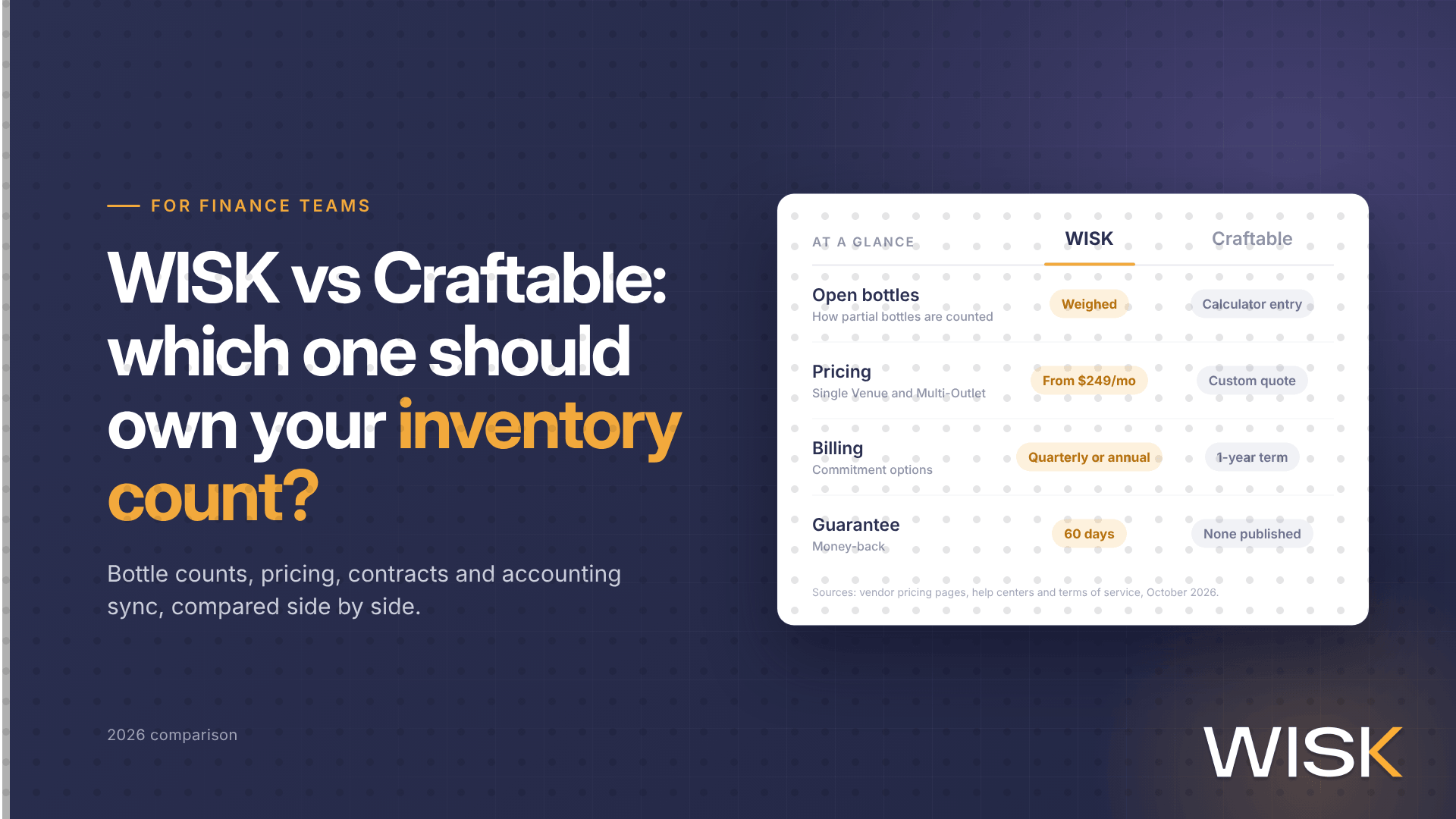
- Partial-bottle method: WISK can weigh open bottles on supported Bluetooth scales. Craftable's help center describes entering counts with a calculator (+1, −1, +.1, −.1) and a bottle icon for opened bottles, and none of the help articles we reviewed mention scales.
- Price transparency: WISK publishes Single Venue and Multi-Outlet prices from $249 a month per location, billed annually, and a setup fee for every tier, from $750. Enterprise is quoted. Craftable lists its own starting price as "Custom quote"; G2 shows a starting price of $250 per location per month, from data last updated in October 2024.
- Commitment: WISK offers quarterly or annual billing and a 60-day money-back guarantee. Craftable's terms of service set a one-year initial term that renews automatically, with renewal increases capped at 5% per term.
- AP and accounting: Craftable leads. It matches invoices to purchase orders and delivery receipts, suggests GL codes, routes approvals, pays bills and lists 35+ ERP, accounting and BI connections. WISK pushes approved invoices to QuickBooks Online and exports to other systems, and WISK Enterprise adds API and data warehouse access.
What are WISK and Craftable?
WISK (wisk.ai) is a food and beverage inventory management and cost-control platform for restaurants, bars, hotels and multi-unit hospitality groups. Teams count with the WISK mobile app, Bluetooth scales and barcode scanning. WISK turns invoices into item costs and reports COGS and actual-versus-theoretical variance. It sells Beverage, Food and F&B Bundle plans for single venues, multi-outlet properties and enterprise groups.
Craftable (craftable.com) describes itself as a back-office platform for restaurants and hotels that manages purchasing, inventory, accounts payable and financial reporting in one place. It sold its products as Bevager and Foodager until a February 2020 rebrand, and in June 2025 extended its platform into hotel operations with procure-to-pay and business intelligence.
Neither replaces your accounting system. Craftable says so in its own finance-team guide ("Craftable doesn't replace your accounting system"), and WISK sends bills and exports to the accounting system you already run.
What finance teams need from inventory management software
Inventory software produces two numbers your team books: the ending inventory value, which sits on the balance sheet, and COGS, which is calculated from it.
COGS = beginning inventory + purchases − ending inventory
Every dollar of error in the ending count moves that period's COGS by the same dollar in the opposite direction, then reverses into the next period through the opening balance. A count that is $2,000 high understates this month's COGS by $2,000 and overstates next month's by the same amount.
So a finance-team evaluation starts with six questions:
- How is the count measured? Weighed, scanned or estimated.
- How current are item costs when the count closes? That depends on how quickly invoices become item costs.
- Can a closed period be locked? And who can reopen it.
- Do transfers between outlets leave an audit trail?
- How do the numbers reach the general ledger? Direct sync, file export or API.
- What will it cost, all in, and on what terms?
Craftable's own finance-team buyer's guide, published in August 2026, scores software on AP automation, accounting integration, live reporting, margin tracking, AP and AR coverage, and multi-location control. How the count is measured isn't on that list. For a controller, it's the input every other number depends on.
WISK vs Craftable at a glance
In our assessment, WISK leads on three of the nine criteria: how open bottles are measured, price transparency and commitment terms. Craftable leads on two, AP automation and ERP connections, and four are even. The sections below cover each one. For a feature-by-feature view of counting and bar tools, see the WISK vs Craftable comparison page.
How do WISK and Craftable count partial bottles?
WISK can weigh them. The WISK mobile app connects to supported third-party Bluetooth scales. With a bottle's full and empty weight on file, WISK calculates how much liquid remains from the scale reading. Without an empty weight, it uses the full weight and the density of the item's category. Counters can also scan barcodes or count visually against a database of more than 200,000 bottles. Several people can count the same area at once: counts sync across devices in real time when online and stay on the device when offline.
Craftable's documentation describes a calculator. Counters type a quantity or tap +1, −1, +.1 or −.1, and select a bottle icon for opened bottles. The app scans barcodes, supports two external scanners and stores counts offline until it reconnects. None of the Craftable help articles we reviewed mention Bluetooth scales or weighing.
The difference matters to finance because any count that records open bottles by eye rests on judgment. If counters estimate to the nearest tenth of a bottle, each open bottle can be off by up to half a tenth before anyone misjudges a tapered shoulder or a dark bottle. Take 150 open bottles at an average cost of $35. If every estimate leans the same way, $262.50 of ending inventory rests on judgment each count, and it moves the month's COGS dollar for dollar. Random misses partly cancel; consistent ones, such as a team that always rounds up, don't.
Adjust the numbers to match your own bar program:
A scale replaces the judgment with a weight reading. What remains is the scale's resolution and the bottle data on file, which stay the same from one count to the next and from one counter to the next.
How long does an inventory count take?
Counting time is a labor cost too. It is the gap between the last pour and a number your team can close on, and every back-office labor hour spent counting is an hour not spent closing.
At The Brass Tap, a craft beer bar franchise, managing partner Sid Patel runs four locations on WISK. Weekly inventory took up to six hours before WISK and about 90 minutes after. "We are happy because it cut our inventory time more than half," he says. He tried four other inventory systems first and tested WISK at one location before rolling it out. He also uses cost alerts: he enters what he pays for an item and sets an alert on it. This is a WISK customer account, not a head-to-head test, and the case study doesn't name the systems Brass Tap used before.
Invoices, item costs and accounts payable
Inventory value is only as current as the item costs behind it, so invoice capture is part of the count. It matters for groups with multiple locations too: in WISK's multi-location price benchmark, 46.5% of products bought by more than one location in the same group were priced differently between locations.
WISK captures invoices by photo, scan, email or upload and extracts line items with AI. Plans include 75 AI invoices a month on Single Venue, 200 to 600 on Multi-Outlet and unlimited on Enterprise, which adds EDI (electronic invoicing) vendor integrations and human-in-the-loop invoice validation. WISK's help center documents invoice imports from Sysco, Gordon Food Service, US Foods and FinTech, an alcohol invoice service, and imported invoices stay in draft until someone reviews and approves them. Approval adds the items to stock and updates their costs. Daily and weekly summary emails list cost changes, item alerts fire when a cost passes a set amount, and POS item alerts flag a dish or drink whose cost percentage reaches your threshold.
Craftable runs its Invoice AI by default and states 99%+ accuracy for known vendors and 95% for new ones. Its AP automation matches invoices to purchase orders and delivery receipts, blocks approval when an invoice exceeds the delivery receipt by more than a threshold you set, suggests GL codes from vendor and item history, routes bills for approval and syncs them to accounting. It also alerts you to price changes when approving invoices, accepts electronic invoicing through EDI feeds from certain vendors, and runs bill payments by ACH, eCheck or check.
If you want the inventory platform to run AP as well, Craftable covers more of that workflow. If AP already lives in your accounting system or an AP tool, what you need from inventory software is a measured count and current item costs before the count closes.
How do the numbers reach the general ledger?
WISK pushes approved invoices to QuickBooks Online as bills, and returns as vendor credits. GL accounts, taxes and suppliers sync from QuickBooks Online daily. Every line needs a GL account before export, and the invoice total must match the paper total within $0.50. GL mapping follows item, then family, then distributor. QuickBooks Desktop users export .IIF files, other systems take an XLS export, and WISK Enterprise includes API and data warehouse access. Item costs default to the most recent invoice price, with a weighted-average option.
Craftable lists more than 35 ERP, accounting and BI connections, including QuickBooks, Sage Intacct, Oracle NetSuite, R365, M3, Microsoft Dynamics GP, Acumatica and Bill.com. Its help center notes that direct sync is available with certain accounting types, such as QuickBooks Online, R365 and Bill.com, while others use an XLS download. Its NetSuite integration syncs bills, credits and inventory count values to GL accounts as journal entries.
If your GL runs on NetSuite or Sage Intacct and you want a native connector, Craftable has the longer list. WISK's direct sync is QuickBooks Online.
Variance, food cost and the period close
WISK locks each inventory 45 days after it's submitted by default. You can shorten that to one day in Venue Settings, and only an account Admin can unlock it. Once an inventory is locked, its sales, consumption and variance figures don't change, and no one can add or edit movements dated before it. Every count produces an actual-versus-theoretical variance report automatically, in wholesale cost and in retail dollars of lost sales. WISK calculates COGS the standard way: starting inventory plus invoices minus ending inventory.
Craftable closes a period with each full audit; partial audits don't close periods. In Director, Craftable's multi-store add-on, audits can lock automatically after a set number of days, including as soon as they close. Its reports compare theoretical and actual COGS by location, department and daypart.
Both calculate theoretical cost from POS sales and recipes, so the POS system and the recipe costing behind it matter. WISK lists 60+ POS integrations on its pricing page, including Toast, Square, Lightspeed, Oracle MICROS Simphony and Agilysys, and syncs with Toast every few minutes. It maps menu items to recipes to calculate cost and profit per item, prices recipes and batch recipes from current inventory costs, records waste, and uses variance analysis to flag losses from over-pouring and spillage. Craftable lists 60+ POS integrations, calculates plate costs from live vendor pricing and tracks waste.
Both cover the close. WISK's timed locking is a venue setting; Craftable's is configured in Director.
Multi-outlet hotels and restaurant groups
The WISK Multi-Outlet Property plan covers 2 to 10 outlets on one bill and one dashboard, priced by band: $499, $899 or $1,250 a month for Beverage or Food, and $799, $1,499 or $1,999 for the F&B Bundle. It includes cross-outlet transfers, a property-level dashboard, outlet-by-outlet variance, custom roles and WISK suggested ordering. When stock levels fall below par, WISK creates a purchase order for review. A transfer deducts stock from the sender and creates a draft invoice for the receiver, and WISK logs every request, approval, rejection, shipment and receipt. WISK Enterprise, priced by quote, adds multi-property roll-up reporting for hospitality groups and restaurant chains.
Craftable tracks inventory at the outlet level and values transfers between departments within a property. Multi-store roll-up runs through Director, which its help center calls "an addition to your Craftable subscription"; G2 lists "Craftable + Director" as "Contact Us". Partners named in Craftable's June 2025 hotel launch include Marriott International, Pyramid Global Hospitality and Sage Hospitality, and it integrates with M3 and Actabl's ProfitSword.
Pricing, contracts and time to go live
WISK publishes its Single Venue and Multi-Outlet prices. Single Venue plans cost $249 a month for Beverage or Food and $399 for the F&B Bundle, per location, billed annually; annual billing saves 17% compared with quarterly. The one-time setup fee runs from $750 for a single venue to $4,500 for an 8–10 outlet F&B Bundle, and Multi-Outlet 4–7 and 8–10 plans billed annually include implementation at no extra cost. Enterprise subscriptions are quoted, with setup from $7,500. There's no free trial; WISK offers a 60-day money-back guarantee instead. Your rate is locked for the term you sign, and WISK's terms ask for written notice 30 days before the next billing cycle to cancel. WISK says most customers go live in two weeks, starting with beverage.
Craftable doesn't publish prices, and its own comparison table lists "Custom quote". G2 lists a starting price of $250 per location per month and "Contact Us" for Craftable with Director, from pricing data last updated October 9, 2024, and says Craftable doesn't offer a free trial. Craftable's terms of service set a one-year initial term that renews automatically for one-year terms unless either side gives notice at least 30 days before it ends; after the initial term, increases are capped at 5% per renewal term. Craftable says most integrations "go live within days, not months." On G2, reviewers report an average of 4 months to implement Craftable (10 responses); G2 shows no comparable figure for WISK.
For a finance team building a budget line, the practical difference is whether you can model year-one cost before the first sales call.
When is Craftable the better fit?
Craftable is the better fit if you want accounts payable, approvals, three-way matching and bill pay in the same platform as inventory. It is also the better fit if your GL runs on an ERP Craftable connects to natively, such as NetSuite or Sage Intacct, and you'd rather not work from file exports or an API.
If your priority is a weighed count and a software cost you can budget before the demo, WISK is the better fit, and the stronger Craftable alternative for finance teams.
Questions to ask when comparing Craftable alternatives
- Weigh an open bottle in front of me. What does the app record?
- Which method sets item cost: last invoice price, weighted average or something else?
- What locks a period, who can reopen it, and what changes when they do?
- When stock moves between outlets, what's logged, and does the receiving outlet get an invoice?
- Which accounting systems sync directly, and which need a file export?
- What is the all-in year-one cost, including setup and add-ons, in writing?
- What are the renewal terms and notice period, and how are renewal prices set?
How we compared
WISK published this comparison. We used each company's public website, help center, terms of service, blog and press releases, and G2's Craftable pricing and comparison pages, accessed October 23, 2026. Calls marked "in our assessment" are WISK's; vendor claims and third-party figures are labelled as such. Prices are in US dollars. Features and prices change, so check both vendors' current terms before you sign.
Sources. WISK: pricing page; terms of service (§19); WISK vs Craftable comparison page; The Brass Tap case study; Toast integration, recipe costing, invoice management, central stockroom and actual-vs-theoretical pages; Help Center articles on Bluetooth scale weighing, offline counting, inventory locking, QuickBooks Online and Desktop, GL accounts, item costing, COGS, cost alerts, and the Sysco, Gordon Food Service, US Foods and FinTech integrations; WISK's multi-location price benchmark (October 2026). Craftable: homepage; AP automation, inventory, integrations, full-service hotels and terms of service pages; Learning Center articles on the inventory app, taking an audit, partial vs. full audits, Director, days to lock audits, 3-way matching, promo threshold, Invoice AI, NetSuite integration and syncing with Books; the February 2020 rebrand announcement; press releases of January 28, 2025 (Actabl), June 12, 2025 (hotel operations) and November 10, 2025 (Invoice AI); the blog post "Best restaurant management software for finance teams (2026)" (August 25, 2026). G2: Craftable pricing page and Craftable vs MarginEdge comparison page.