How Do You Catch Ingredient Price Spikes Before Month-End?
Catch the spike on the invoice, not the P&L. Put a cost alert on every high-spend ingredient, size each threshold to how volatile that ingredient is, rule out invoice errors, and re-cost the affected dishes the day the alert fires.
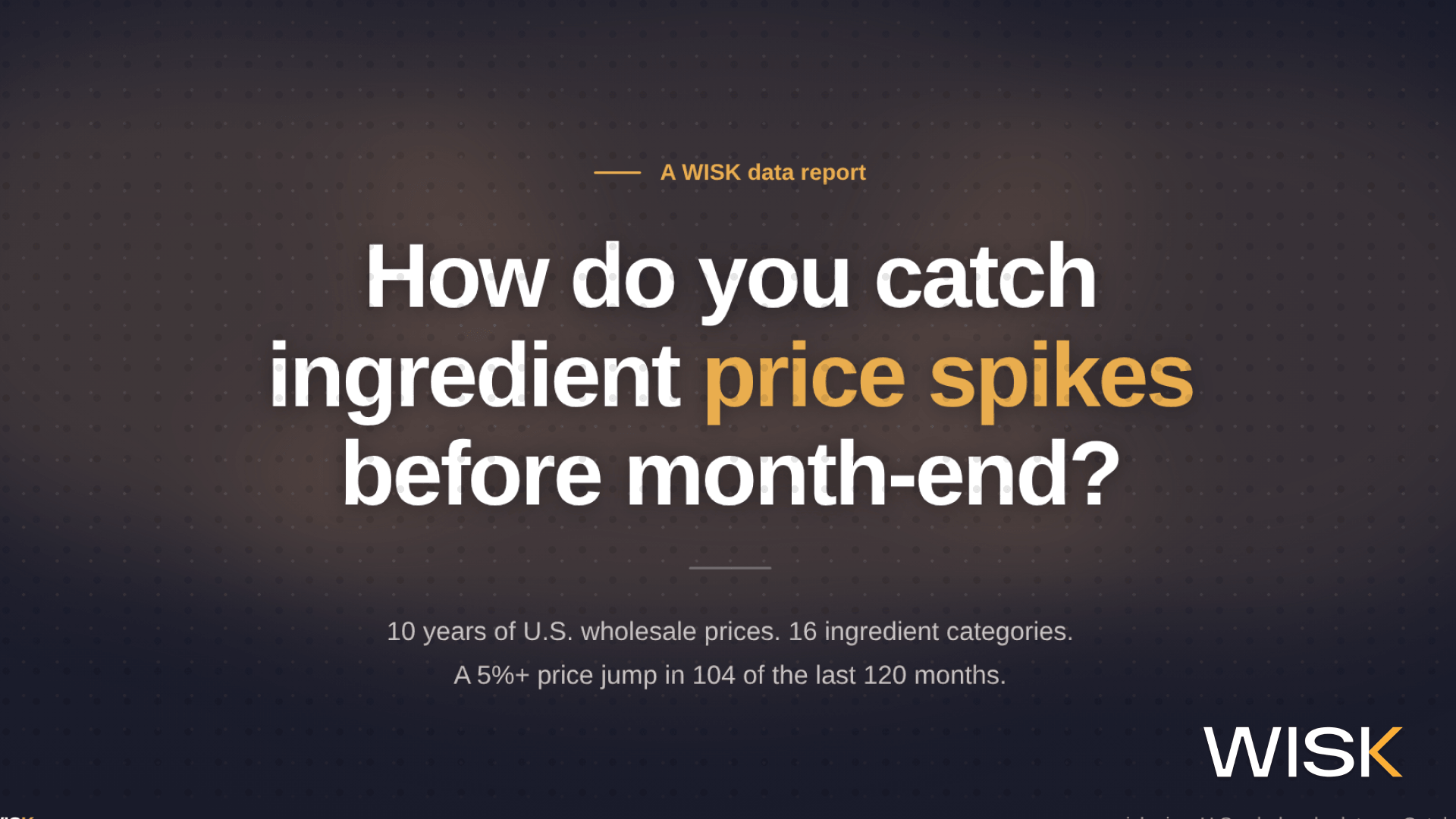
The data shows why speed matters. WISK analyzed 10 years of U.S. wholesale food prices: in 104 of the last 120 months, at least one of 16 restaurant ingredient categories jumped 5% or more in a single month, and most of those jumps were still in place three months later.
This guide is for multi-unit operators, purchasing managers and chefs. It covers alert thresholds by ingredient, what to check before you act, when to re-cost versus wait, and how to set it all up with WISK Item Cost Alerts and POS Item Cost Alerts. If your problem is slow, repeated increases rather than sudden jumps, start with how WISK captures price creep from every invoice.

How often do ingredient prices spike?
At least one of 16 restaurant ingredient categories jumped 5% or more at wholesale in 104 of the last 120 months, according to WISK's analysis of U.S. Bureau of Labor Statistics producer price data.
In 78 of those months, at least one category jumped 10% or more. A typical month brings 1.8 categories with a 5%+ jump.
Eggs and fresh produce drive part of that, but not all of it. Leave out eggs, fresh vegetables and fresh fruit, and a 5%+ jump still shows up in 58 of 120 months. Beef, pork, poultry or seafood jumped 5% or more in 37 months, roughly one month in three.
It isn't slowing down. Seafood just posted its biggest one-month rise in the 10 years we analyzed: +9.6% in September 2026 (preliminary). USDA's Economic Research Service forecasts wholesale beef prices up 8.8% in 2026, and restaurant menu prices up 3.5% in 2026 and 2.8% in 2027.
Why is month-end too late to catch a price spike?
The P&L shows one blended food cost percentage up to six weeks after a price change lands, so one ingredient's jump gets averaged away while every delivery in between is paid at the new price.
Here's an illustrative example. A 12-location burger group gets an October 2 invoice that moves ground beef from $5.40 to $5.95 a pound, a 10.2% jump. Each location uses about 250 pounds a week, so the increase costs $137.50 per location per week.
If the October P&L gets reviewed around November 10, the group pays the higher price for about five and a half weeks before anyone looks. That's roughly $9,000 across 12 locations, on one ingredient.
At the plate, a 6-ounce patty goes from $2.03 to $2.23. On a $16 burger with a $4.80 plate cost, food cost moves from 30.0% to 31.3%. A blended monthly number hides that. A dish-level alert is built to catch it.
What price alert threshold should you set for each ingredient?
Match each threshold to the ingredient's volatility: about 2–3% for bread, flour, coffee, milk and alcohol, 5% for poultry, pork, seafood, cheese and oils, and 10% for beef, butter and fresh fruit.
An alert that fires every week gets ignored. One that never fires misses the spike. The goal is an alert that only fires when a move is unusual for that ingredient.
So we set each category's starting threshold just above its normal month-to-month movement. Over the last 10 years, each of these thresholds would have fired in at most about one month in eight at wholesale.
For eggs and fresh vegetables, a percentage trigger doesn't work. A 13–20% move is a normal month for these items (lettuce alone moved a median 30% a month), so any threshold low enough to matter fires constantly. Alert on the dish instead: set a POS Item Cost Alert at the food cost percentage where each egg- or produce-heavy dish stops working, and let the ingredient move.
Treat these as starting points. Your invoices are noisier than a national index because of pack changes, promotions and distributor switches. Review alert volume after 30 days. If an item alerts every week, raise its threshold. If a known increase slipped through, lower it.
How do you set up price spike alerts in WISK?
In WISK, use two alerts: an Item Cost Alert on high-spend ingredients, which emails you when a unit cost reaches your trigger price, and a POS Item Cost Alert on each dish's food cost percentage.
Both are checked when an invoice is added, meaning when a scanned draft is reviewed and converted into an invoice. Convert drafts yourself and the alert can go out the same day. If WISK's team processes your invoices, typical turnaround is 3 business days. Either way, you hear about it weeks before month-end. Set it up in five steps.
1. Get invoices in the day they arrive. An alert is only as fast as the invoice behind it. WISK takes invoices as a photo or scan from the mobile app, a web upload, an email to each venue's upload address, or a supplier integration or EDI. On plans that include invoice processing, WISK's team enters each invoice and confirms the data. Make the back-door photo part of receiving, upload through the month instead of in a month-end batch, and require invoice photos in Venue Settings if you need to. (More on WISK invoice processing.)
2. Put Item Cost Alerts on your top-spend ingredients. In the Web Portal, open Items, click Edit on an item and enter a trigger cost and unit in the Cost Alert field (setup guide). WISK alerts on a price, not a percentage, so convert: trigger = current cost × (1 + threshold). Chicken thighs at $2.10/lb with a 5% poultry threshold get a trigger of $2.21/lb. Use the Missing Cost Alert filter to find high-spend items without one, and reset the trigger whenever you accept a new baseline price.
3. Put POS Item Cost Alerts on your menu. On the POS Items page, set a Cost Alert at the target food cost for each dish. Or select several dishes and use Relative Cost Alert, which sets each one's alert a set percentage above its current cost percentage (setup guide). WISK re-checks a dish when an invoice raises an ingredient's cost, when the menu price changes in your POS, or when the recipe changes. The email shows the alert level, the cost percentage before and after, the menu price and the updated cost.
4. Send each alert to the person who can act on it. Alerts only go to users enabled for the Item Distributor Cost Alert and POS Item Cost Alert emails under Email Report Permissions. Route ingredient alerts to whoever orders at that location, and dish alerts to the chef or GM who owns the menu.
5. Read the Price Changes table for everything under your thresholds. WISK's daily and weekly summary emails include a Price Changes table that lists items whose cost moved and links into the Web Portal (details). That's where the smaller increases show up.
One setting to check: WISK Bar and WISK Restaurant venues cost items at the most recent invoice price by default, so a jump moves your costs as soon as the invoice is converted. If you've turned on Weighted Average Pricing, new prices blend with stock on hand and costs move in smaller steps. Set triggers with that in mind.
Is it a real price spike or an invoice error?
Check four things before you act: unit of measure, pack size, substitutions and discounts, because a case price keyed as a unit price looks exactly like a spike in any costing system.
- Unit of measure. A cost per case entered as a cost per unit is the classic false spike. WISK's own help center uses it as the example. Open the item's cost history (Items, then the arrow in the Cost per Unit column) to see each invoice's date, distributor, quantity and cost. Invoice costs show in blue, manual edits in black.
- Pack size. A distributor swapping a 40 lb case for a 30 lb case at the same case price has raised your cost per pound by 33%.
- Substitutions. An out-of-stock item replaced with another brand or grade often comes at a different price.
- Discounts and credits. A rebate or promotion that dropped off looks like an increase. WISK records line discounts and invoice-level charges and credits, so check whether one is missing.
Then ask whether it's the market or your supplier. Stable categories rarely move much on their own. In 10 years of wholesale data, bakery products never rose more than 2.3% in a month, and alcoholic beverages never more than 1.4%. A 10% jump on your bread or spirits invoice is a supplier decision or a data-entry error, not the market. Ask for a credit or check the contract before you re-cost.
Also check your other locations. In WISK's October 2026 benchmark of 122 groups, 46.5% of products bought by more than one location were priced differently between locations. A jump at one store may be specific to that store's distributor or contract.
Should you re-cost the menu or wait the spike out?
Usually re-cost: of 211 monthly jumps of 5% or more, 62% were still at least 5% above the pre-spike price three months later, and only 26% fully reversed.
The split by volatility gives you a rule of thumb:
- Stable and moderate categories (flour, coffee, milk, cheese, poultry, pork, seafood, oils): 73% of jumps were still in place after three months, and 13% fully reversed. Treat the new price as real. Re-cost, then reprice, re-spec or rebid.
- Volatile categories (beef, butter, fresh fruit): 61% stuck and 20% fully reversed. Re-cost right away so you can see the damage. Use short-term moves first, such as a different cut, a smaller garnish or a market-price special, and reprice if the increase holds into a second month.
- Eggs and fresh vegetables: 36% fully reversed within three months, but 58% were still 5% or more above the old price. Protect the dish rather than chase the ingredient. Hold menu prices, flex portions or substitutes, and let the dish-level alert tell you when the margin is actually broken.
In WISK, the re-costing itself is automatic. When an invoice updates an ingredient's cost, every recipe, sub-recipe and menu item that uses it is re-costed (WISK recipe costing). So the question isn't "what does this dish cost now?" but "which dishes crossed the line?"
Start with the POS Item Cost Alerts that fired. Multiply each dish's cost increase by its weekly sales from your POS, and work the list from the biggest dollar impact down. To find the menu price that holds your target food cost, use the free Price Increase Worksheet, and see how to optimize your menu prices before you change them.
How should multi-unit groups manage price alerts across locations?
Set thresholds centrally, route alerts locally and review them weekly as a group, because 46.5% of products bought by more than one location are priced differently between locations, per WISK's 2026 benchmark.
A group average hides a spike at one store. A location on a different distributor or an expired contract price can pay 10% more for the same item while the group number barely moves. In the same benchmark, 92% of groups had at least one product where locations paid 10% or more apart.
A simple operating rhythm:
- Corporate purchasing sets thresholds by category, using the table above, so every location alerts on the same rules.
- Each location's alerts go to the person who orders there. Dish-level alerts also go to the culinary lead who owns the recipe.
- Agree on a response window, such as confirm or dispute within one business day.
- Hold a 15-minute weekly review. Cover which alerts fired, which were errors, which were market moves, and which locations pay more for the same item. Use it to trigger rebids and tune thresholds.
Each WISK venue keeps its own item costs, invoice history and alert recipients, so a spike at one location is flagged at that location. If you run a central stockroom in WISK, it places all external orders to distributors, so route ingredient alerts to central purchasing and keep dish-level alerts at each outlet. See how WISK works for restaurant groups and chains.
When don't you need automated price alerts?
If you run one location, buy from two or three suppliers and enter every invoice yourself, a weekly spreadsheet check of your top 25 items can catch most spikes without software.
Alerts also aren't the first fix if most of your spend is on fixed-price contracts. There, the risk is invoices that don't match the contract, so audit invoice prices against contract prices instead.
And no alert beats a slow invoice process. If invoices sit in an office for two weeks before anyone enters them, any tool, WISK included, will tell you late. Fix receiving first. Here's how to stop entering invoices by hand.
FAQ
Methodology
WISK analyzed the U.S. Bureau of Labor Statistics Producer Price Index (not seasonally adjusted), retrieved from FRED, for 16 food and beverage categories restaurants buy. We measured 120 month-over-month changes, from October 2016 to September 2026.
Series: beef and veal (WPU022101), pork (WPU022104), processed poultry (WPU0222), seafood (WPU0223), eggs for fresh use (WPU017107), fresh vegetables except potatoes (WPU011302), fresh fruits and melons (WPU0111), fluid milk (WPU0231), butter (WPU0232), cheese (WPU0233), shortening, cooking oil and margarine (WPU0278), flour and flour mixes (WPU0212), bakery products (WPU0211), processed fruits and vegetables (WPU024), coffee (WPU026301) and alcoholic beverages (WPU0261).
A "5%+ jump" means a category's index rose at least 5% from the prior month. "Typical monthly move" is the median absolute monthly change, and "big month" is the 90th percentile. Suggested thresholds sit just above each category's normal movement. "Would have fired" counts the months the index rose by at least the threshold. Persistence compares each 5%+ jump with the index level three months later, covering 211 jumps from November 2016 to May 2026.
Limitations: the PPI tracks wholesale and farm-level prices, not your distributor's invoice price, which can move later, by a different amount, or be fixed by contract. Individual items are noisier than category indexes. The latest four months of PPI data are preliminary and may be revised. Lettuce (WPU01130215) is cited as an example only and isn't in the 16-category totals.
WISK (wisk.ai) makes inventory, invoice processing and recipe costing software for restaurants, bars and hotels.