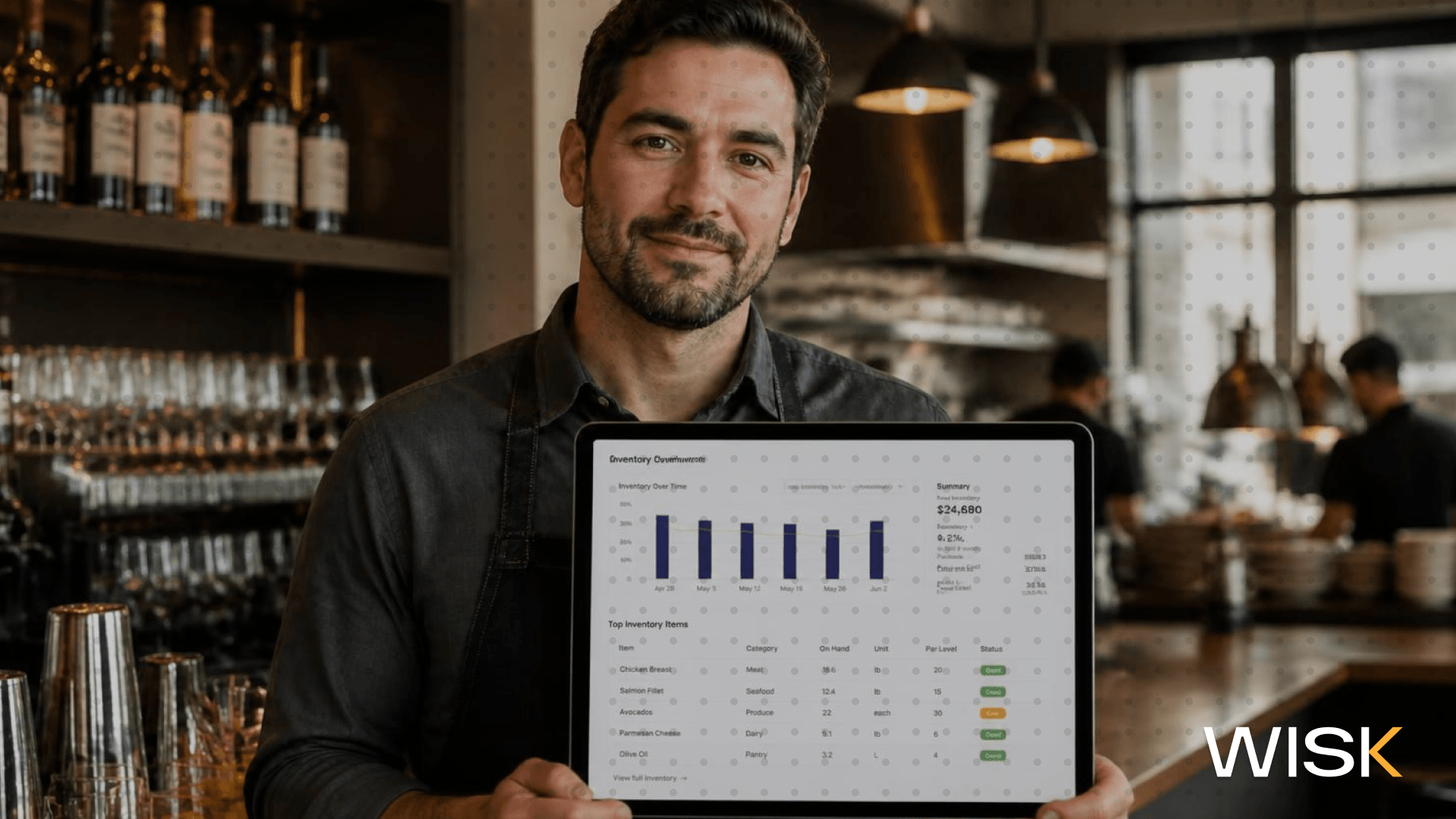
The Bottom Line: You hit your food cost target by making it a live number instead of a month-end autopsy. Food costing software prices every recipe against current invoice prices, so the food cost % of a dish updates the moment an ingredient price moves. WISK does this automatically with real-time COGS updates, a recipe costing calculator, and a menu profitability dashboard — you set the target, the system holds the line.
What does food costing software actually do?
Food costing software connects your invoices, vendor price lists, and recipes into one source of truth, so every recipe cost recalculates itself when an ingredient price changes. Most operators get back 4–5 hours a week of admin work that used to disappear into spreadsheets.
It replaces three separate jobs you're probably doing by hand right now:
- Ingredient prices: invoices from suppliers are read and matched to your items, so ingredient costs update without anyone retyping a line.
- Recipe costs: plate cost, sub recipes, and batch yields calculate together instead of living in five tabs of one Excel file.
- Menu pricing: every dish carries a current food cost %, so menu costs and profit margins are visible before you print anything.
The point isn't reporting. It's that the number is right on a Tuesday afternoon, not two weeks after you needed it.
How does real-time recipe costing keep your food cost percentage on target?
Real-time recipe costing recalculates plate cost the moment a new invoice lands, so your food cost % reflects what you paid this week. A 5% move in ingredient costs shows up instantly on the exact dishes affected instead of surfacing as a margin gap at month-end.
That matters more in 2026 than it did five years ago. The USDA's Economic Research Service projects all-food prices rising about 3.1% this year, with beef and veal moving several times faster than the average. If your ribeye recipe costs were set in January, they're wrong now.
- WISK real-time COGS updates re-price every recipe that uses an ingredient the second its price changes.
- You see which dishes crossed your target, not just that the overall food cost went up.
- Culinary directors can fine tune portion specs or swap a component before the P&L takes the hit.

What's the real difference between costing recipes in Excel and costing them in WISK?
Spreadsheets give you a snapshot; food costing software gives you a live system. The difference shows up in three places: how long an update takes, how many dishes get re-priced when a vendor raises a price, and whether your multi unit locations are working from the same numbers.
How do you price a new dish so it hits margin on day one?
Work backwards from the target, not forwards from the ingredients. Take your true plate cost — including sub recipes, prep yields, and waste — and divide by your target food cost % to get the menu price the dish needs to carry.
Run a dish through the calculator below before it goes on the menu. It's the same math WISK's recipe costing calculator does automatically across every recipe in your program.
- If the required price is above what your guests will pay, the fix is the recipe, not the price tag.
- Menu development gets faster when you can test three ingredient swaps in a minute instead of rebuilding a spreadsheet.
- F&B directors can model a whole menu's profit margins before a single plate leaves the pass.
Why do sub recipes, pack sizes, and yields break manual food costing?
Manual menu costs usually fail at the conversion layer, not the arithmetic. A house demi that's used in nine dishes, a case-to-each pack size change, or an unrecorded trim yield can put your recipe costs off by 15–20% while every formula in the sheet still looks correct.
- Sub recipes: cost the batch once, then let it flow into every dish that uses it. Change the batch, change all nine dishes.
- Pack sizes: when a supplier switches from a 4/1 gal case to 6/750ml, the unit cost changes even if the invoice total doesn't.
- Yields: you buy 10 lb of whole fish and plate 4.2 lb of it. Costing on purchase weight understates every portion.
This is the quiet reason two operators with identical purchases report different food costs. One is costing what they bought; the other is costing what they served.
How do you keep food costs consistent across multiple locations?
Multi unit consistency comes from a single shared database of items, recipes, and vendors — not from sending a template to each GM. One recipe change publishes to every location at once, and each unit still sees its own local ingredient prices.
- Compare the same dish across locations to see who's over-portioning and who's paying more for the same case.
- Roll up food cost, waste, and variance by region or by unit without merging files.
- Standardize order guides so units stop buying the same product from three suppliers at three prices.
The National Restaurant Association reports that 90% of full-service operators raised menu prices and 63% sought alternative suppliers to absorb cost pressure. Both moves only work if you can measure the result per location, per dish.
Which dishes on your menu are actually making money?
Menu engineering tools rank every item by contribution margin and popularity, so you can see the difference between a dish that sells and a dish that pays. In most programs, a handful of high-volume items are quietly running 8–12 points above target food cost.
- The menu profitability dashboard pairs sales data from your POS with live recipe costs, so profitability is measured on today's ingredient costs.
- Low-margin, high-volume items are the fastest fix: a small portion or spec change on a best-seller beats a price increase on a slow mover.
- Variance and waste tracking compares theoretical usage against actual inventory counts, which is where over-ordering, comps, and theft show up.
With the industry projected to reach $1.55 trillion in sales in 2026 on thin margins, knowing which dish funds your operation isn't a nice-to-have report.
How does WISK help you hit your food cost targets?
WISK gives restaurant owners, culinary directors, and F&B directors one system for inventory, invoices, recipe costing, and menu engineering — so your target food cost % is a setting you manage, not a number you find out about. Invoices update ingredient prices automatically, recipes re-cost themselves, and the menu profitability dashboard shows you exactly which dishes are carrying your margins and which ones are eating them.
Book a free WISK demo and see your own recipe costs, live, in under 30 minutes.